In London – Energizing the Old Masters market
Newly discovered and long lost works generally add a jolt to the Old Masters market and an array of paintings in the July evening auctions at Sotheby’s and Christie’s in London are worthy of attention, including a pair of portraits by Rembrandt, and pictures by Pieter Brueghel the Younger and Michael Sweerts. And there are others that return with new attributions, the newly cleaned, and the occasional work that just can’t seem to find a buyer no matter how often it appears with an increasingly lower estimate. Add in a smattering of still lifes and vedute plus some portraiture and you have a sale.

Allegory of Spring
Oil on panel: 16 1/8 x 22 3/4 in. (41 x 57.8 cm.)
Estimate: £600,000-800,000 – This work sold for a hammer price of £1.4 million (£1,734,000 with fees)
At Christie’s there are several works that are “fresh” – those attracting the most media attention are the Rembrandt portraits, more about them below. Let’s start with an Allegory of Spring by the perpetually market friendly Pieter Brueghel the Younger, a thoroughly capable and entertaining artist who made a career largely of reproducing his father’s works (this was the subject of a 2002 exhibition in Maastricht and Brussels, Brueghel Enterprises, for which there is an excellent catalogue). Indeed, there is a whole subsection of the Old Masters market devoted to works by the many Brueghels (Pieter the Elder, Pieter the Younger, Jan the Elder, Jan the Younger, etc.). The discolored varnish notwithstanding, the picture is a delight filled with numerous vignettes of spring time village life: eight workers tend a formal flower garden; three figures wrestle with sheep they’re shearing, while another carries a basket of newly shorn wool; across a stream in an open expanse before a row of thatched roof houses a dozen or so figures are dancing (though one seems to have been overserved – he’s tended by a woman as he vomits); there are pigs and ducks; a young figure fishing; and others going about their day.

Conceived as part of a series about the seasons, the original by Pieter the Elder from 1565 is in the Albertina in Vienna. There are some twenty autograph versions by Pieter the Younger; this one carries a £600,000-800,000 estimate. According to the sale catalogue: “Spring was evidently one of the more frequently requested seasons from Pieter the Younger as an individual painting. In the certificate for the painting by [leading Brueghel scholar] Dr. Klaus Ertz, dated 27 February 2018, confirming the attribution after first-hand examination, Dr. Ertz rates the present work among the most well preserved versions.” The quality, condition, and the fact this previously unpublished work has been in the same family for more than a century will likely result in a hefty price.

The Artist’s Studio with a Seamstress
signed and inscribed ‘Michael Sweerts / Roma’ (lower left, on the paper)
oil on canvas, unlined: 31 3/8 x 42 3/4 in. (79.5 x 108.4 cm.)
Estimate: £2-3 million – This work sold for a hammer price of £10.7 million (£12,615,000 with fees) – the top lot in the sale
Among the more enigmatic of the “fresh” works is The Artist’s Studio with a Seamstress by the equally enigmatic Michael Sweerts, who began his career in Brussels before heading to Rome in the mid-seventeenth century, became religiously devout, went mad, and died on the Indian Ocean island of Goa while on a religious pilgrimage to China. The painting incorporates several typologies: the right includes an artist at his easel, a musician, and a few other individuals; the center is littered with numerous fragmentary sculptures from antiquity and by contemporary artists; and the left side shows a seamstress studiously working on the elaborately embroidered hem of a piece of fabric. The darkened varnish obscures and hides additional details including paintings hung high on the wall behind the key figures (likely depictions of Sweerts’ own paintings), and an anteroom with more staffage.
Sweerts painted other images of the artist’s studio (the Rijksmuseum, Amsterdam, and the Detroit Institute of Arts) along with the seamstress (Trustees of the Berkeley Will Trust, Berkeley Castle). According to the sale catalogue: “The [present] composition itself is familiar to us by virtue of a number of versions and copies, the best of which – in the Rau Foundation – has variously been described by scholars as by or after Sweerts.” This work at Christie’s, which is a masterpiece, should go into a public collection.
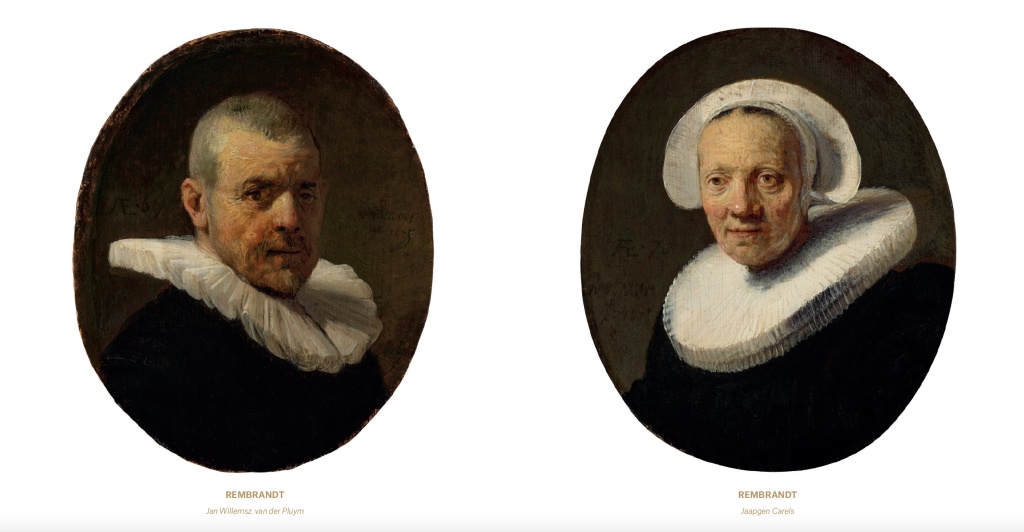
Portrait of Jan Willemsz. van der Pluym (c.1565-1644), bust-length; and Portrait of Jaapgen Carels (1565-1640), bust-length
the first signed and dated ‘Rembrandt / f. 1635’ (centre right), indistinctly signed ‘Remb[…]’ (lower right), and inscribed ‘Æ 69’ (centre left); the second signed, dated and inscribed ‘Æ 70 / Rembrandt / f. 1635’ (centre left)
oil on panel, oval: the first 8 1/2 x 6 5/8 in. (20.8 x 16.7 cm.); the second 7 3/4 x 6 1/4 in. (19.9 x 16.7 cm.)
(2)a pair
Estimate: £5-8 million – This pair sold for a hammer price of £9.5 million (£11,235,00 with fees)
The powerful and small Rembrandt portraits were last sold 199 years ago – at Christie’s – and have remained in the same collection ever since. Dated 1635, they depict husband and wife Jan Willemsz. van der Pluym and Jaapgen Carels, distant relatives of the artist who were also his friends.

The Crucifixion with the Virgin, Saint John the Baptist and the Magdalen
tempera on gold ground panel, arched, the original engaged frame regilded: 25 1/8 x 15 in. (59.7 x 34.2 cm.)
Estimate: £4-6 million – This work sold for a hammer price of £4.1 million (£5,001,000 with fees)
England’s great houses are home to numerous gems, some of which are occasionally sold to pay for debts or fixing roofs, etc. While we don’t know the reason, the Marquess of Northampton is parting ways with an early crucifixion by Fra Angelico, the fifteen-century genius of Florentine painting. Against a gilt background we see the crucified Christ flanked by two airborne angels; Mary Magdalene kneels holding the base of the cross, with the Virgin Mary on one side and Saint John the Baptist on the other. The figure of the Baptist is particularly glorious. One can see the outline (incised into the surface) that surrounds the figure; he wears a gilt-trimmed blue floor-length tunic over which is a gilt-trimmed salmon-colored cloak with beautifully modeled shadowing. His face is an expression of beatific grief and his head is surrounded by a halo of radiating incised lines and circular punchwork.

The Raising of Lazarus
signed in monogram and dated ‘CvH . 1602 .’ (lower right)
oil on panel: 63 1/2 x 74 in. (161.4 x 188 cm.), including a later horizontal addition to the upper edge of 16 3/8 x 74 in. (41.6 x 188 cm.)
Estimate: £700,000-1 million -This work sold for a hammer price of £1.1 million (£1,371,000 with fees)
Another country house, Ragley Hall, is selling a large oil on panel depiction of The Raising of Lazarus by the Dutch Mannerist painter Cornelis Corenlisz van Haarlem. The picture, dated 1602, was commissioned by Jan Matthijsz. Ban who is seen on the far right looking at the viewer and gesturing with his right hand to the standing Christ and with his left hand to the recumbent Lazarus. The figures typologically derive from Italian precedents (though none witnessing the miracle are seen holding their noses against the stench of the decomposing corpse as depicted by Italian artists including Giovanni di Paolo and Sebastiano del Piombo). The scene is grand and theatrical.

Portrait of Sophia Coymans (1636-1714), three-quarter-length, holding a twig with an orange, before a landscape
signed ‘B . vander. helst . f .’ (lower left)
oil on canvas: 42 5/8 x 34 7/8 in. (108.2 x 85.9 cm.)
inscribed with the sitter’s family coat-of-arms (upper right)
Estimate: £200,000-300,000 – This work sold for a hammer price of £400,000 (£504,000 with fees)
A work making its auction debut is the elegant Portrait of Sophia Coymans (1636-1714), three-quarter-length, holding a twig with an orange, before a landscape, by the seventeenth century Dutch painter Bartholomeus van der Helst. The work has stayed within the family since it was commissioned. The young woman depicted wears an extraordinary dress whose details – shimmering silk and satin, delicate lacework, and intricate embroidery – are brilliantly rendered by this skilled portraitist.

Portrait of a lady, bust-length
oil on panel: 10 1/4 x 8 1/4 in. (26 x 21 cm.)
Estimate: £800,000-1.2 million – This work sold for a hammer price of £850,000 (£1,068,500 with fees)
In the “Oops” department: a decade ago New York’s Metropolitan Museum of Art deaccessioned a bust-length portrait of a lady “attributed to” the early Netherlandish painter Hans Memling; the picture sold for $482,500. Though the work had been considered autograph for much of the twentieth century, the Met’s curator, Maryan Ainsworth, labeled it as “attributed to” the artist in the 1998 Van Eyck to Bruegel: Early Netherlandish Painting in The Metropolitan Museum of Art exhibition catalogue. Now it returns without that price-killing qualifier and with a hefty estimate of £800,000-1.2 million.

A triptych: The Adoration of the Magi
oil on panel, shaped top: the central panel: 42 1/4 x 30 in. (107.3 x 76.2 cm.); the wings: 41 3/4 x 13 in. (106 x 33 cm.)
Estimate: £150,000-250,000 – This lot sold for a hammer price of £130,000 (£163,800 with fees)
Another work making a return engagement is a triptych depicting the Adoration of the Magi by the early sixteenth century painter known as the Master of the Antwerp Adoration. The period during which the as yet unidentified artist was active was the focus of a 2005-2006 exhibition in Antwerp and Maastricht, ExtravagAnt! A Forgotten Chapter of Antwerp Painting, 1500-1530 (for which there is an excellent, though hard to find catalogue). The picture was sold a decade ago for more than $530,000 to the present owner; it came back to auction on July 29, 2020, with an estimate of £300,000-500,000 and failed to sell. Now it’s back with a £150,000-250,000 estimate.

Hell
signed and dated ‘·BRUEGHEL 1601·’ (lower left)
oil on copper: 14 1/8 x 10 1/2 in. (27 x 36 cm.)
Estimate: £1.5-2.5 million – This work sold for a hammer price of £1.2 million (£1,492,000 with fees)
One last work at Christie’s that dazzles with details is a small oil on copper (some fourteen by ten inches) by Jan Brueghel the Elder that depicts Hell. The Dutch and Flemish depictions of the underworld – from Van Eyck, to Bosch, Brueghel, and others – often feature a cornucopia of tortured souls, various demons and monsters, metamorphosed figures, vertiginous landscapes, serpents, snakes, the occasional cauldron, fires, flying beasts, and other assorted oddities.

Most have as a nominal focal point some Christian subject matter or classical mythology about which is embroidered the maniacal scenes; this picture is a rare exception. It’s just pure, unconditional hell.

active in Bruges circa 1490
Pentecost
oil on panel: 106 x 122 cm.; 41¾ x 48 in.
Estimate: £7-10 million – This work sold for a hammer price of £7 million (£7,897,800 with fees)
There is less at Sotheby’s that catches my eye, but there are some standouts starting with a large, dramatic, and richly detailed Pentecost from about 1490 by an artist active in Bruges with the provisional name of The Master of the Baroncelli Portraits (which refers to the portraits of Pierantonio di Guaspare Bandini-Baroncelli and his wife Maria Bonciani today in the Ufizzi). The picture was sold at Christie’s on December 7, 2010, to the London-based dealer Jean-Luc Baroni, for nearly £4.2 million (against an estimate of £1.0-1.5 million), from whom it was acquired by the current seller. Now shorn of its discolored varnishes and dirt, it carries a £7-10 million estimate.

The Virgin is seated in the center surrounded by eleven apostles; in the lower register left and right, dressed in black, are male and female donors, respectively, who presumably commissioned the work. Unfortunately a full coat of arms, which would help identify the two patrons, is not visible. The scene is in the present day and there are vignettes through an open door and window to the town outside; a second door opens into another room. It’s a wonderful image.

Siegen 1577–1640 Antwerp
Saint Sebastian tended by two angels
inscribed with an inventory or collection number lower left: 99
oil on canvas: 124 x 97.8 cm.; 48¾ x 38½ in
Estimate: £4-6 million – This work sold for a hammer price of £4.2 million (£4,895,600 with fees)
Though I’m not keen on Rubens (and even much less so El Greco, and don’t get me started on Renior), the roughly three- by four-foot Saint Sebastian tended by two angels is impressive and commanding. A slightly larger version (with two additional angels) can be found in Rome’s Galleria Corsini. The present work was misattributed when it was last sold, some fifteen years ago, as a work by the Rubens’ younger French contemporary, Laurent de la Hyre.

Venice 1697–1768
Venice, a view of the Piazzetta with the southwest corner of the Doge’s Palace; Venice, a view of the quay of the Dogana
inscribed by an eighteenth-century hand on a label on the reverse: Canaletto.fe
a pair, both oil on canvas, laid on panel (probably pine), each: 28 x 37.5 cm.; 11 x 14¾ in.
(2)
Estimate: £3-4 million – This lot sold for a Hamme price of £1.7 million (£2,037,000 with fees)
Also purchased by Jean-Luc Baroni in 2010 are the pair of Canalettos – Venice, a view of the Piazzetta with the southwest corner of the Doge’s Palace; Venice, a view of the quay of the Dogana – featured in the present sale. Baroni paid $3,890,500 in January 28, 2010 (the same sale had a glorious reliquary by Francesco di Vannuccio) and sold them to the collector that has put them back on the market where they’re estimated a £3-4 million. We’ll see if they break even (UPDATE: they didn’t).
Along with these two evening sales, there are ancillary auctions of Old Master drawings, lesser priced day sale paintings, sculpture and statuary, along with another trove of works from the Safra Collection sold without reserve.
It’s a lot to absorb.
What else besides that $200 million Warhol?

signed and dated ‘Andy Warhol / 64’ (on the overlap)
acrylic and silkscreen ink on linen, 40 x 40 in. (101.6 x 101.6 cm.)
Painted in 1964.
Est. in the region of $200 million This lot sold for a hammer price of $170 million ($195,040,000 with fees)
The potential for Andy Warhol’s Shot Sage Blue Marilyn to sell for more than $200 million in Christie’s May 9, 2022, sale of “The Collection of Works from Thomas and Doris Ammann” has generated headlines globally and resurrected the deliciously peculiar story behind the painting’s title (more on that later).
But there are two other works in the sale that are noteworthy – a pair of paintings from 1961 by the American artist Robert Ryman, the jazz aficionado and one-time guard at New York’s Museum of Modern Art, whose “white paintings” dare, challenge, enthrall, and seduce human perception much like Donald Judd’s sculptures.
The two works, both untitled, are comprised of Ryman’s characteristic jumble of thickly painted narrow and short squiggly white lines. Peeking out under some of these white strokes are hints of underpaint in shades of green and ochre, a colorful foundation obscured through an evolutionary path to the white surface.
Surprisingly, the compositions don’t seem chaotic; indeed, the aggregation of agitated brushstrokes is suggestive of a colony of bees moving about in a putatively random fashion but ultimately with a shared goal. An equilibrium for the chaos/calm. Another giveaway of the artist’s control and deliberate intent is the precision of the rendering and placement of his signature, which both identifies the author and is a functional element in the overall composition.

signed and dated ‘RRyman 61’ (lower center)
oil on Bristol board, 12 x 12 in. (30.5 x 30.5 cm.)
Painted in 1961.
Est: $1.5 – 2.5 million This lot sold for a hammer price of $3.2 million ($3.7 million with fees)
The first of the two works is intimate in scale – 12 x 12 inches. The oil on Bristol Board composition could be mistaken for an aerial image of a coastline. More than 85% of the board is covered with overlapping brushstrokes, nearly all white, but hints of the board and green underpaint peek through, and there are discreet passages in taupe, including the artist’s “RRyman61” signature. The composition (landmass) is bulbous and the pigments’ oils bleed into the board along the vertical border of the painted and unpainted areas. The oil-soaked passages suggest coastal shallows that presage the deep end.
Ryman’s career began in the late 1950s and by 1961 the foundation of his vision and path had been established with small scale works that juxtaposed paint, support, textures, volume, and void. While I don’t find this painting among the strongest from that era (there are several superb examples from the artist’s collection featured in the 1993 exhibition organized by the Tate and MoMA), it is solidly representative and authoritative in its own right. It carries an estimate of $1.5 – 2.0 million.

signed ‘Ryman’ (lower left)
oil on linen, 66 1⁄2 x 66 3⁄4 in. (169 x 169.5 cm.)
Painted circa 1961.
Est. $15 – 20 million This lot sold for a hammer price of $17.25 million ($20,141,250 with fees)
The second work is an oil on linen that measures roughly 5.5 feet by 5.5 feet. The composition is small square of vigorous white brushstrokes within a larger square of nearly imperceptible and wide white brushwork. The smaller square is lodged in the upper right corner of the work and occupies perhaps 40-45% of the overall composition. There are hints of green and ochre underpaint, and portions of the linen support poke through in places. It’s a masterful contrasting of paint textures, volume and void, and the precise “Ryman” signature at lower left completes the composition and brilliantly counterbalances the writhing network of paint in the upper right. The painting is estimated at $15 – 20 million.
As for Warhol’s Shot Sage Blue Marilyn, here’s the story behind its title as recounted in the sale catalogue:
This paintings (sic) also enters ‘Warhol-lore’ as one of the famous Shot Marilyns, a group of four paintings involved in an infamous event that took place at the Factory in the fall of 1964. Warhol had just completed a set of five 40 x 40 inch canvases of Marilyn (the four Shot Marilyns plus Turquoise Marilyn) using his new screening process, when he was visited by his friend Ray Johnson and a woman named Dorothy Podber. She was a sometime performance artist and the owner of outlandish pets including an ocelot which she took for walks around New York’s Central Park. She was also known as a photographer and when she entered the Factory and saw Andy silkscreening, she asked if she could shoot them. Assuming that she meant photograph his latest work, Warhol agreed. Podber promptly took a gun from purse and fired a single shot at the canvases leant up against the wall. She then put the gun back in her purse and left.
The sale takes place at Christie’s offices in New York. It should be entertaining.
SOLD for €6.2 Million to the Met in New York – An exceptionally rare painting by the 14th century Master of Vyšší Brod at auction in France

Master of Vyšší Brod (Bohemia, ca. 1350), Madonna and Child Enthroned, devotional panel, egg tempera on fruit tree wood panel, 26 x 20.2 cm.
Estimate: €400,000-600,000.
UPDATE: This painting sold for a hammer price of €5 million (€6.2 million with the buyer’s fee) to the Metropolitan Museum of Art, assuming that an export license is granted.
ORIGINAL POST: Eric Turquin is having a good year. This past June the Paris-based Old Master painting expert was a featured player in the sale of purported Caravaggio (that was originally slated for auction with an estimate of some €150 million). He then identified a small panel painting as a lost work by Cimabue that sold for a remarkable €24,180,000 (including fees) at auction on October 27, 2019. Now he says that a Madonna and Child found in Dijon, France is a rare painting by the 14th century Master of Vyšší Brod – and it’s being auctioned this Saturday, November 30, 2019, and carries an estimate of €400,000-€600,000.

Master of Vyšší Brod (Bohemia, ca. 1350) the Annunciation.
Unless you’ve been to the Saint Agnes convent in Prague, or you have a yen for medieval Bohemian art, you’ve probably not heard of this as yet unidentified painter (a good resource on the period is Prague, The Crown of Bohemia, 1347–1437, the catalogue that accompanied the Metropolitan Museum of Art’s 2005 exhibition – it’s available as a free down load). The Master’s moniker derives from a cycle of paintings from c. 1350 by him and his workshop depicting Christian themes and the life of Christ that were created for the Cistercian Monastery Church of the Assumption in Vyšší Brod. The paintings are now housed in a single room at the museum in the Saint Agnes convent. Four of the nine paintings – the Annunciation (above), the Nativity (below), the Adoration of the Magi and the Resurrection – are considered autograph, the remainder are considered to be largely by his workshop.

Master of Vyšší Brod (Bohemia, ca. 1350) the Nativity.
A museum panel about the works says: “With its artistic concept the cycle represents a characteristic Central-European synthesis of the West-European linearly rhythmical style with colorful finesse of the Italian (Tuscan) paintings, a situation typical of Prague around the mid-14th century. Its anonymous author ranks among the most noteworthy painters of Central Europe. The original purpose of the cycle remains unclear.”

Master of Vyšší Brod (Bohemia, ca. 1350), the Annunciation, detail.
Characteristics of the Master’s work and those in his circle are the rich fabrics, frequently embroidered with delicate gilt detailing (Annunciation detail, above), the idiosyncratic and craggy landscape features, and the striking use of architectural embellishments as framing devices for the narratives. The Glatz Madonna in Berlin (below) by one of his followers shows the Master’s influence.

Bohemian Master, c. 1343-44, Glatz Madonna
Tempera on canvas over a poplar panel: 186 x 95 cm
According to the auction house, the background of the newly discovered painting is a later addition. Infrared radiography (below) reveals that the Madonna and Child are framed by an intricate architectural background featuring a niched surrounded by two tiers of columns and other elements.

Master of Vyšší Brod (Bohemia, ca. 1350), Madonna and Child.
Infrared radiography reveals architectural embellishments hidden by overpaint.
A careful cleaning could reveal the original background and allow this gem to shine again.

Judith and Holofernes, c.1607.
Oil on canvas: 56 11/16 x 68 5/16 in.
ArtNews, citing a Reuters report, says the Judith and Holofernes by Caravaggio discovered in a French attic in 2014 has been sold privately and that the Thursday, June 27, 2019 auction of the picture in Toulouse has been cancelled. This is a stunning development in the extraordinary five year saga of this picture. Now the guessing game begins about the identity of the buyer (UPDATE: The New York Times and other media outlets report the buyer is J. Tomilson Hill).
According to the ArtNews article:
Reuters reported on Tuesday that Marc Labarbe, an auction house in Toulouse, France, has called off its planned auction of the Caravaggio painting Judith and Holofernes (1607), which had been given an estimate of €150 million ($170 million). The sale was planned for Thursday, and it was expected to set a new auction record for the Italian master.
According to Marc Labarbe, the painting “sold privately to a foreign buyer.” Citing a confidentiality agreement, the auction house declined to offer the name of the buyer or the price for which the work sold.
The cancelation of the auction marks yet another strange development in a sale that already had been shrouded in mystery. Judith and Holofernes was rediscovered in an attic in 2014, in the Toulouse home of one of Labarbe’s friends, and it has since become the subject of intrigue.
Is this really a missing Caravaggio?
Photograph ©Nord Wennerstrom, 2019.
Judith and Holofernes, c.1607.
Oil on canvas: 56 11/16 x 68 5/16 in.
“You’re here to see the Caravaggio?” said the guard at Adam Williams Fine Art, a private art gallery on East 80th Street on Manhattan’s Upper East Side one block from the treasure-filled Metropolitan Museum of Art. Billed as one of the greatest Old Master painting discoveries in decades, one would have expected a line out the door to see the Judith and Holofernes by the famous 17th-century Italian artist, known for his revolutionary painting style and tempestuous personal life, which had been found in an attic in Toulouse, France on April 23, 2014, by the Toulouse-based auctioneer Marc Labarbe. It was publicly unveiled two years later.
However, during my visit on the final day of the picture’s public viewing in New York (part of a multi-city media campaign), I was often the only person in the light-filled second floor room devoid of furniture save for a small writing desk and chair at one end and “the painting” at the other.
I was glad for the luxury of having one-on-one time with this dramatic, gory and compelling composition rather than having to jostle with a scrum of noisy observers loudly opining about whether this is a real Caravaggio.
Eric Turquin, a representative for the firm handling the forthcoming June 27, 2019 auction in France of the painting, where it could sell for more than €150 million, indicated both surprise and disappointment with the lack of attendance. He lamented the absence of visits by museum curators, specifically mentioning the National Gallery of Art, a museum that he praised as one of the world’s best, but one he noted that lacked a Caravaggio.
For the past five years, since announcing the discovery of the painting, Turquin has been actively promoting the work as a “great original by Caravaggio,” as he says in a video on the website The Toulouse Caravaggio. The website includes testimonials from various experts about the painting’s veracity, though in his “report” about the picture, the Metropolitan’s Keith Christiansen opens with the following observation: “From the first time I saw the picture in May, 2015 and became convinced of its authorship, I also recognized that this was one of those pictures that would not achieve a consensus among specialists.”
The authorship of the work has been actively debated as attested to by dozens of media reports. Turquin has supporters who see the work as “autograph” in art world parlance, some have argued that this Judith is by the late 16th/early 17th-century Baroque Flemish painter/dealer Louis Finson who worked in France, while another school of thought holds that the work may be by Caravaggio and a contemporaneous or subsequent collaborator.
The downloadable 168-page auction catalogue, which covers everything from the iconography of the Israelite widow who decapitates the Assyrian general to technical specifications and the written evidence circumstantially linked to the work, makes a compelling case and is a worthy addition to any library of Italian Baroque painting, especially one focused on Caravaggio and those influenced by the painter.
On Thursday, June 27, 2019, the painting will be auctioned in Toulouse; the event will be live-streamed on The Toulouse Caravaggio website.

Philips Wouwerman, The Departure for the Hunt, c. 1665–1668, oil on panel, 52 x 67 cm (20 1/2 x 26 3/8 in.). National Gallery of Art, Washington. The Lee and Juliet Folger Fund, in honor of Earl A. Powell III, Director of the National Gallery of Art (1992–2019)
Click on image to enlarge.
The National Gallery of Art in Washington, D.C., has announced some recent acquisitions that includes Philips Wouwerman’s The Departure for the Hunt.
According to the announcement:
Among the most elegant and accomplished of Wouwerman’s late works, The Departure for the Hunt depicts a party preparing for a falcon hunt in front of an elegant country estate. A master of narrative detail, Wouwerman filled the scene with lively vignettes of pages carrying falcons and bringing wine; a huntsman sounding the horn to signal the start of the event; and a merry company enjoying a peacock pie feast on the terrace above. Combining a subtle palette of browns with a striking blue sky and employing periodic accents of bright color throughout, the artist captured both the elegance of this aristocratic pastime as well as the majestic beauty of the countryside. Best known for his depictions of equestrian subjects, Wouwerman executed some 600 paintings over the course of a short career, spending his final years painting highly refined variations on the theme of the hunt.
Purchased with funds from The Lee and Juliet Folger Fund, in honor of Earl A. Powell III, Director of the National Gallery of Art (1992–2019), this painting is the second work by Wouwerman to enter the Gallery’s collection, joining Battle Scene (c. 1645/1646).
The picture appeared at Christie’s July 6, 2010 Old Masters Evening Sale in London, where it sold for £1,217,250 (inclusive of fees) against an estimate of £1,000,000-1,50,000. The sale catalogue essay noted:
Recognised since the eighteenth century as one of Philips Wouwerman’s ‘chefs-d’oeuvre’, the importance of this picture was signalled most recently by its selection for the first major monographic exhibition of the artist’s work held at the Mauritshuis in 2009-10.
This is a quintessential example of Wouwerman’s most refined late style, generally dated to the last few years of his life (1665-8). Given the great extent of Wouwerman’s painted oeuvre (over six hundred works have been attributed to him), it is often forgotten that he died relatively young, before he reached the age of fifty. Hunting scenes featuring richly attired figures attended by pages, grooms and dogs provided the artist with a favourite source of subject matter during the 1650s and ’60s, and this is one of his most eloquent treatments, which amply illustrates his versatility as an outstanding painter of architecture and landscape in addition to his pre-eminence as a horse painter. The main action is overlooked by a party on a terrace, attended by musicians and pages serving food. A courting couple are shown on a balcony below, alongside a monkey who signifies their amorous intentions. The group on the terrace, together with the figures on the steps below, occur, in the reverse sense, in a sheet in the British Museum, thought to be a counter-proof of a preparatory study in red chalk.
Pictures of this type by Wouwerman were especially prized in France in the eighteenth century, and this example has the distinction of having been owned successively by the two most illustrious French collectors of this artist–Jeanne-Baptiste d’Albert de Luynes, comtesse de Verrue (1670-1736) and Pierre-Louis-Paul Randon de Boisset (1710-1776). The former, who was among the earliest collectors in France to buy Dutch pictures, owned more than a dozen paintings by Wouwerman, the majority of which are now housed in museums, including five in the Gemäldegalerie, Dresden, and such masterpieces as the Stag Hunt (Louvre, Paris), Horses watering (Rijksmuseum. Amsterdam) and the Horse Fair (Wallace Collection, London; for a full account of her collecting, see J. Scott, ‘The Comtesse de Verrue: A lover of Dutch and Flemish Art’, Apollo, January 1973, pp. 20-4). The comtesse’s prediliction for Wouwerman was disseminated by virtue of engravings made by Jean Moyreau after some of her best works by Wouwerman, and the present picture was among the first to be reproduced in this way in 1734 (see fig. 2). Her taste helped inspire unparalleled levels of interest in the artist and no doubt influenced the taste of Randon de Boisset, who acquired the present work at, or soon after, the comtesse de Verrue’s estate sale in 1737. His own sale, held after his death forty years later, contained twelve paintings by Wouwerman, of which this picture achieved the highest price.
Until 1784, this painting was always sold with another, on canvas, described as its pendant; but, as Quintin Buvelot has recently made clear, this owed simply to the fashion for presenting Wouwerman’s paintings as pairs, made easy by the frequent similarity of size and subject in his oeuvre.

The Master of the Legend of Saint Ursula, (active Bruges, 1470-1500). “Saint Veronica and the Sudarium”
Oil and gold on panel: 31 x 25 cm.
Click on image to enlarge.
A rare work in excellent condition by an as yet unidentified late 15th century Flemish master has been acquired by the Groeningemuseum in Bruges, Belgium. Saint Veronica with the Sudarium, (ca. 1500) by the Master of the Legend of Saint Ursula came to the Bruges institution via “an auction house in New York,” according to CODART, and, “It will go on display at the Groeningemuseum in March 2019.” The Flemish daily De Standard reports the sale was brokered by Sotheby’s and the purchase price was €570,000 plus an import tax of €34,000, all provided by the Museum Collection Fund.
The painting depicts Saint Veronica holding up a cloth with an image of Jesus on it. The apocryphal saint encountered Jesus in Jerusalem on what is now the via Dolorosa as he carried the cross to his crucifixion. She wiped the sweat from his face and his image miraculously appeared on the cloth. Saint Veronica does not appear in the New Testament; her name is likely a combination of vera (true) and ikon (image), and Jacobus Voragine made her story popular in the 13th century Golden Legend.

Detail – The Master of the Legend of Saint Ursula, (active Bruges, 1470-1500). “Saint Veronica and the Sudarium”
Oil and gold on panel: 31 x 21 cm.
Click on image to enlarge.
The panel painting, with its arched top, depicts the saint against a gilt background. Her elaborate clothing and headdress are bejeweled, and veils on either side of her head are animated in the wind. Christ is shown looking straight ahead at the viewer and is depicted in exacting detail.

Master of the Legend of Saint Ursula (active Bruges, 1470-1500). “Saint Veronica with the Sudarium”
Oil and gold on panel: 59 x 37 cm.
click on image to enlarge.
RKD – Netherlands Institute for Art History lists a comparable composition (above) in the Countess Durrieu Collection in Paris. There are subtle differences that may be due to overpaint that has been removed, however the Paris image measures 59 x 37 cm., substantially larger than the work purchased by the museum, which does not appear in the RKD inventory.

The Master of the Legend of Saint Ursula (active Bruges, 1470-1500)
Angels supporting the Veil of Saint Veronica
oil and gold on oak panel, in an engaged frame
24 3/8 x 17 3/8 in. (61.9 x 44.1 cm.)
Click on image to enlarge.
A comparable, somewhat larger work appeared at Christie’s in New York in January 28, 2015, though the image of Christ is held aloft by two angels and the backdrop is the exposed red ground from whichthe gilding is largely gone. The painting was estimated at $250,000-350,000, and sold for $509,000 (hammer price + buyer’s fees).
This type of image is known as an acheiropoietos in Greek,” according to Martin Kemp, author of Christ to Coke: How Image Becomes Icon. “An acheiropoietos or non manufactum (not made by any hand) was an image that appeared miraculously, without any intervention by a human maker. No painting or other artifice was involved. The artifex (maker) was Christ himself.”

The Master of the Legend of Saint Ursula, (active Bruges 1470-1500). “The Legend of Saint Ursula of Cologne”, 1482.
Oil on panel: 120 cm x 155.5 cm.
The Master of the Legend of Saint Ursula was active in the last quarter of the 15th century; his provisional name comes from the art historian Max J. Friedländer after an altarpiece showing scenes from the Life of Saint Ursula, appropriately enough, in the Groeningemuseum. His work shows the influence of both Rogier van der Weyden and Hans Memling. However, the museum’s former curator, Till-Holger Borchert, based on an examination of the panels’ underdrawings beginning in September 2002, concluded that it was the work of several distinct masters. By contrast, in 2004, the Bruges historian A. Janssens identified the artist as Pieter Casenbroot (1436-1504/1505) according to RKD – Netherlands Institute for Art History. At present there are only some dozen or so works attributed to this master (or masters).

Detail – The Master of the Legend of Saint Ursula, (active Bruges 1470-1500). “The Legend of Saint Ursula of Cologne”, 1482.
Oil on panel: 120 cm x 155.5 cm.
Click on image to enlarge.

The Master of Saint Veronica
ACTIVE IN COLOGNE C. 1395–1415
A PORTABLE TRIPTYCH CENTRE PANEL: VIRGIN AND CHILD ENTHRONED BEFORE A GOLDEN MANDORLA, WITH GOD THE FATHER AND ANGELS IN ADORATION ABOVE, SAINTS JOHN THE EVANGELIST, BARBARA, CHRISTINA, CATHERINE, MARY MAGDALEN AND JOHN THE BAPTIST SEATED IN A SEMI-CIRCLE BELOW INNER WINGS: THE CROWNING WITH THORNS, THE CRUCIFIXION, THE RESURRECTION AND THE ASCENSION OUTER WINGS: THE WAY TO CALVARY
oil on oak panel
central panel: 70 x 32 cm.; 27 1/2 x 12 1/2 in.
two wings, each: 70 x 16 cm.; 27 1/2 x 6 1/4 in.
Click on image to enlarge
An exquisite triptych from c. 1410, called “one of the finest examples of early German Gothic art still in private hands” was acquired by Rotterdam’s Museum Boijmans Van Beuningen at Sotheby’s December 5, 2018 Old Master Painting sale in London, according to the museum’s press release. The painting by the Master of Saint Veronica, Lot 6 in the sale, sold for a hammer price of £1.3 million (£1.57 million with fees-slightly more than $2 million), against a pre-sale estimate of £1.2-1.8 million. The museum’s release states that the acquisition was made possible by “a generous donation from the Rembrandt Association, Mondriaan Fund, the BankGiro Lottery, the Stichting Bevordering van Volkskracht, the Prins Bernhard Cultuurfonds (also thanks to the Breeman Talle Fund), the Museum Boijmans Van Beuningen Foundation and a number of private donations.”
The painting had been featured in the museum’s 2012 exhibition “The Road to Van Eyck” and had been high on exhibition curator Friso Lammertse’s acquisition list, who notes: “The painting shows in an incredibly beautiful way the elegance and refinement that is so typical of International Gothic. It is a key piece of this period, deeply moving, especially because of the sweetness in the central panel that contrasts strongly with the scene on the outside where a lonely Christ carries the cross.”
The Sotheby’s catalogue entry states:
This beautiful and intensely personal triptych was painted in Cologne around 1410. It is one of the earliest and most complete surviving works of art of its type, and certainly one of the finest examples of early German Gothic art still in private hands. In its refinement and exquisite detail it exemplifies the contemporary taste for beautiful courtly works of a small scale. Although the precise identity of its creator has not yet convincingly been determined, the Master of Saint Veronica was undoubtedly the most important of the painters who introduced this International Court style to Cologne at the beginning of the fifteenth century, thus laying the foundations for the Cologne school under the great Stefan Lochner a generation later.
The triptych, still intact, has the format of a portable altar, the inside panels framed, the reverse sides unframed for ease of transport. When closed the triptych shows a remarkably stark image of Christ on the path to Calvary. With the wings open, the central panel depicts the Virgin and Christ Child seated in a meadow, surrounded by six saints.

Detail showing the Madonna and Child with God the Father looking over.
Unusually, in this representation, Mary is both the Virgin of Humility – seated on the ground – and the Queen of Heaven, encircled by a host of angels with God the Father at the summit. The Virgin in the central panel is set against a gilded mandorla that dominates the painting. Her halo is particularly fine, and within it her crown decorated with pearls and jewels. The mandorla’s highly decorative quality is emphasised by intricate punch work of lines that radiate from a second halo. Brocade robes and decorative embellishments abound, particularly in the figures of the female saints, who are seated around her and all bear their traditional attributes. The four female saints are from left to right: Saint Barbara, holding a model of the tower in which she was incarcerated; Saint Christina of Bolsena, with one of the instruments of her torture; Saint Catherine, beside the wheel to which she was bound and the sword of her execution; and Mary Magdalen, her ointment jar held delicately between her fingers. The names of the two more prominent saints are spelt out in pearls on their crowns. Behind this quartet are Saint John the Evangelist and Saint John the Baptist.
When open, the wings depict four scenes from the Passion, chosen deliberately to emphasise, on the left, Christ’s suffering, and on the right, his Resurrection. The Crowning with Thorns is surmounted by The Crucifixion; and, on the opposite side, The Resurrection is painted below The Ascension. The attributes of the male saints in the centre panel would seem to underscore this distinction between Christ’s mortality and his divinity. Saint John the Evangelist holds the chalice with its Eucharistic associations, while Saint John’s lamb is emblematic of Christ’s role as redeemer. The gesture of the Christ Child grasping the golden pearls of his mother’s rosary is at the centre of the painting and is emblematic of atonement. The iconographical intent behind this selection of Passion scenes and Saints would seem to be intensely personal, and may very well have been the specific choice of the patron for whom the triptych was painted. The penitential message of the altarpiece offers a message of both hope and salvation and thus echoes the writings of Thomas à Kempis, who encouraged his followers to ‘assume your cross and follow in Jesu’s footsteps, and you shall enter Eternal Life!’.
This exceptionally rare work is unanimously attributed to the Master of Saint Veronica. Almost nothing is known about the artist, only that he worked in Cologne in the early years of the fifteenth century. Although some attempts have been made to identify him with recorded Cologne masters, such as Herman de Cologne (fl. 1389–1417) or Herman Wynrich von Wesel (d. c. 1413) none has been successful. His name derives from a painting showing Saint Veronica holding the sudarium, originally displayed in the church of Saint Severin in Cologne and now in the Alte Pinakothek, Munich. His work is distinguished by the singular characteristics of the physiognomy of his Saints with their demure, sloping, heavy-lidded eyes and pursed lips, and with the rich colours and decorative patterns of his designs. It has been suggested that he may have worked for a period as an apprentice in the workshop of Conrad von Soest (1370–1422) in Dortmund in Westphalia, for not only do the two artists share several distinctive facial features in their figures but they even have in common some aspects of their workshop practice such as punch marks. From Conrad von Soest it is thought that the Master of Saint Veronica may have introduced the colours ultramarine and lead tin yellow into German practice at this date. The scenes of the Crowning of Thorns, The Resurrection and The Ascension in the present work are derived from compositions of the analogous scenes in von Soest’s Niederwildungen Altarpiece of 1403, now in the Stadtkirche of Bad Wildungen.
This painting shares a number of features with other works attributed to the artist. The facial features of the Saints recall those of the small angels in the Master’s aforementioned eponymous panel in Munich. The scene of the Crowning with Thorns on the left wing adopts the tiled and chequered floor that we see in the same picture. The Master of Saint Veronica uses this device to give a strong sense of spatial recession, a practice rarely explored in this decorative style. The range of colours in the present work, particular the reds and warm pinks, bear close comparison with the Master of Saint Veronica’s Calvary today at the Wallraf Richartz Museum in Cologne (fig. 2).5 The scene on the wing of the triptych omits the throng around the Crucifix and instead centres on the figure of Christ. In pose and rendering, the treatment of the figure bears a strong similarity to the Cologne Calvary. In the present picture, it is particularly worth noting the thoughtful attention given to the gesture of the Virgin, who is shown holding the edge of her headdress as if about to dry her tears.

Master of Saint Veronica
German, active c. 1395/1420
The Crucifixion
c. 1400/1410
tempera on panel
overall (design area): 40.7 x 25.2 cm (16 x 9 15/16 in.)
support: 46.2 x 31.1 cm (18 3/16 x 12 1/4 in.)
framed: 58.1 x 43.8 x 4.4 cm (22 7/8 x 17 1/4 x 1 3/4 in.)
Samuel H. Kress Collection
Click on image to enlarge.
A similar figure occurs in the artist’s Crucifixion today at the National Gallery of Art, Washington (above). The same air of tender devotion in which the relationship between the Virgin and Child is explored with particular charm occurs in another triptych, the so called Virgin with the Sweet-pea Blossom in Cologne.
Although the Master of Saint Veronica was probably not a native of Cologne, his style and its courtly idiom was clearly perfectly in accord with the aspirations of the patrician classes in a city that had only recently entered a period of peace and stability. His works embodied the International Courtly Style that was elegant and worldly on the surface but was also able to convey the solemnity of its religious content. In the early 1400s Cologne society was concerned with displays of wealth and rank, spectacles of chivalry and the splendour of their churches. They were just as preoccupied with death, eternal punishment and the hope of salvation. Commissions of religious works of art such as this important triptych reconciled the conflicting concerns of profanity and penitence. The Master’s ductile handling of oil paint, the delicacy of his colouring and his softly modelled forms, all of which are exquisitely displayed in the present work, answered this need for a hugely decorative and chivalric style that nevertheless answered the spiritual conscience of the newly wealthy.
Restoration of Pieter Bruegel the Elder’s Iconic ‘Dulle Griet’ Reveals New Discoveries

Pieter Bruegel (ca. 1525/30 – 1569). Dulle Griet (after restoration), 1563
Museum Mayer van den Bergh, Antwerp
Click on image to enlarge
CODART has posted news about the restoration of an important painting by Pieter Bruegel the Elder. From their website:
Peter Bruegel the Elder’s Dulle Griet (Museum Mayer van den Bergh, Antwerp) has regained its original appearance with the rediscovery of a blue-green sky. The restoration has revealed Bruegel’s refined brushwork and a number of striking details that were hidden for decades under layers of overpainting and yellowed varnish. Research indicated that the painting does not date from 1561, for instance, but from 1563 – the year in which Bruegel married and moved from Antwerp to Brussels.
Bruegel’s Dulle Griet (‘Mad Meg’) was sent to the Royal Institute for Cultural Heritage (KIK-IRPA) in Brussels for study and restoration in January 2017 and spent over eighteen months there. The painting is now traveling to the Kunsthistorisches Museum in Vienna, where it will be one of the highlights of the large-scale Bruegel exhibition that will open the international celebrations to mark the 450th anniversary of Pieter Bruegel the Elder’s death. It will return to the Antwerp museum in spring 2019.
Spectacular discoveries
The multidisciplinary study made several spectacular discoveries, which amend the results of earlier research performed in 2011 and 2012. The use of new, more advanced techniques allowed the painting’s various underlying layers to be documented and studied one by one. Macro-XRF maps showing the distribution of copper and calcium carbonate reveal that Bruegel did not add the title ‘Dul’ to the panel: the looping inscriptions or scratches were applied later – perhaps accidentally – and were also detected elsewhere in the painting. The dating of the work has also been adjusted by two years, as the date ‘1563’ was discovered on the panel after cleaning and the removal of layers of historical overpainting. The previously accepted date of the work was 1561.

Detail of Dulle Griet after restoration
Click on image to enlarge
Antwerp or Brussels?
The new dating of Bruegel’s Dulle Griet immediately triggered a flurry of debate as to where the artist produced this infernal scene: Antwerp or Brussels? Bruegel most likely married Mayken Coecke at the Kapellekerk in Brussels in August 1563. The banns are documented as having been taken out on 25 July that year at the Cathedral of Our Lady in Antwerp. It is not known precisely when Bruegel moved to Brussels so the question of where the painting was done cannot be answered at this point. He used a similar type of panel in the years both before and after 1563 and we do not know where he purchased them. Nor is it known how long Bruegel worked on a particular painting. Could he have completed this hell scene in the space of just four or five months and was it done entirely in Brussels? Did he finish the painting in Antwerp before moving to Brussels? Or did the artist take the semi-finished panel with him to his new home? Some of the questions surrounding Bruegel’s Dulle Griet, will have to go unanswered for the time being.
Color
The painting was previously known as an obscure, weird landscape with a dark red sky and touches of brown. Technical analysis of a color drawing of ‘Dulle Griet’ in the Kunstpalast in Düsseldorf revealed a considerable amount of information regarding the Antwerp painting’s original palette. The drawing – previously attributed to Pieter Bruegel the Elder himself – turned out to be an early copy after the painting. Its colors are remarkably well preserved and so the sheet offers unique and detailed evidence of the painting’s original colors.

Detail of Dulle Griet after restoration
Click on image to enlarge
Two of the color tones in the panel – blue (smalt and azurite) and green – have lost much of their intensity, altering the scene’s overall appearance. Meg’s dress and the flag, for instance, were originally a deep blue. They were done in smalt, however, which was cheaper and more readily available than the extremely costly lapis lazuli. The pigment azurite (bright to greenish blue) in the sky and hell’s hat also has a much darker appearance. The green pigments of the frog, the foliage top left and the figure in the bottom right now have a brownish tinge.
The work looks much fresher after restoration and shows details that were invisible for many years, such as the teddy bear, the finely executed helmets and the beautiful landscape in the background. The colour palette is lighter and more varied. Bruegel’s brushstrokes and his outstanding painterly skills are visible once more. The sense of space has been fully restored and the entire scene displays much greater depth.
Who the hell is Nosadella?

Lot 34. Giovanni Francesco Bezzi, il Nosadella (Bologna c. 1547-1571)
The Holy Family with Saints John the Baptist and Jerome
oil on panel: 29 7/8 x 24 in. (75.9 x 61 cm.)
inscribed ‘AGNVS’ (lower right, on the banderole)
Estimate: £350,000-550,000. This lot sold for £764,750 ($1,010,999 – a World Record for the Artist).
Click on image to enlarge.
A compositionally congested painting featuring a Madonna and (in the Italian Mannerist tradition her improbably large) Child by the 16th century Bolognese artist Nosadella, originally slated for the April 19, 2018 Old Masters sale at Christie’s in New York (but withdrawn), will come up for sale at the auction house’s London location during the July 5, 2018 evening sale. Update – this painting sold for £764,750 (hammer price plus the buyer’s premium – or $1,010,999) against an estimate of £350,000-550,000.
But, who is this artist?
Details about Giovanni Francesco Bezzi (c. 1530-1571), called Nosadella (after the street in Bologna on which he lived), are scant and few works survive (he worked mostly in fresco and all the works in that medium are believed to have been lost). He apparently studied with Pellegrino Tibaldi (1527-1596) and, according to some sources, frequently traveled and spent time in Rome. Attributions are based on two accepted works in Bologna, a Madonna and Saints of c.1550 in the Oratorio of Santa Maria della Vita and a Circumcision in Santa Maria Maggiore from the year of the artist’s death (the unfinished picture was completed by Prospero Fontana).
Carlo Cesare Malvasia in Felsina Pittrice, 1678, states: “Those few works of him that are known . . . are distinguished by their good color . . . and are full of erudition. And if they are not . . . perfect and studied, they are perhaps more powerful, singular, and resolute.” The Allen Memorial Museum’s website states: “Nosadella seems to have progressed from a heavy, almost sculptural style indebted to Tibaldi’s idiosyncratic interpretation of Michelangelesque mannerism, to a more refined and naturalistic style in the 1560s, reflecting a more Florentine maniera. While there are some lingering similarities between Nosadella’s mature paintings and works by Tibaldi, they are generally more delicate than the latter’s compositions, which are crowded with powerful forms and taut energy. Nosadella’s paintings show a greater emphasis on linear, decorative qualities, more complex arrangements of drapery, and a greater sense of space within the composition.” Despite this stylistic distinction between Nosadella and Tibaldi, several works have alternatively been attributed to the two artists – and two works have a striking compositionally similarity to the picture at Christie’s.

Pellegrino Tibaldi (1527-1596) Holy Family with Saint Catherine
Capodimonte

Giovanni Francesco Bezzi (Nosadella) (Italian, Bologna ca. 1530 – 1571 Bologna)
Holy Family with Saint Catherine
National Museum of Art of Romania
The figure of the Madonna, with her head facing toward her right, and her right arm extended diagonally across the picture plane, appears in a couple of pictures – a Holy Family with Saint Catherine (above) at the Capodimonte in Naples given to Tibaldi and the other, a Holy Family with Saint Catherine (above) at the National Museum of Art of Romania, given to Nosadella.

Nosadella (Giovanni Francesco Bezzi), Italian, active ca.1549–1571, The Annunciation, 1560s
Oil on wood panel: 107.3 x 78.8 cm (42 1/4 x 31 in)
Princeton University Museum of Art
Attributions for other pictures have been debated and changed. The Princeton University Art Museum notes that their Annunciation (above), “once considered a work of the Bolognese master Pellegrino Tibaldi … has now been attributed to Giovanni Francesco Bezzi (called Nosadella), also active in Bologna.” A preparatory drawing by the artist held in a private collection helped secure the authorship.

Nosadella (Italian, 1529-1571) Holy Family with Saint John the Baptist
about 1550-1560
oil on panel: 19-1/2 x 15 in.
Indianapolis Museum of Art
Meanwhile, the Indianapolis Museum of Art’s Holy Family with Saint John the Baptist (above) has had a bit of an identity crisis. In a 1981 article in Perceptions, Martha Levine Dunkelman compared the Indianapolis painting with the two accepted works in Bologna, and concluded on stylistic grounds that that “there is … little reason to connect the Indianapolis Holy Family to Nosadella” (academia.edu members can access this article). The article does make the case that picture should be given to Tibaldi, based in part on the aforementioned Capodimonte picture. Nevertheless, museum’s website now says the work is by Nosadella and states: “Ignored by the artist-biographer Giorgio Vasari and his contemporaries, Nosadella’s oeuvre has been reassessed only recently by scholars, who have been challenged to distinguish his pictures from those of his master, Pellegrino Tibaldi. Even the authorship of The Holy Family with Saint John the Baptist, now confidently attributed to Nosadella, has oscillated between master and student.”

Giovanni Francesco Bezzi (Nosadella) (Italian, Bologna ca. 1530 – 1571 Bologna)
The Presentation in the Temple, ca. 1567
Oil on panel
25 13/16 x 17 5/8 in. (65.6 x 44.8 cm)
Mrs. F. F. Prentiss Fund and R. T. Miller, Jr. Fund, 1982
AMAM 1982.108
Examples of the artist’s work can be found at the Allen Memorial Museum at Oberlin University where in 1982 the eminent scholar of Italian Baroque art Richard E. Spear, the museum’s director at the time, facilitated the museum’s acquisition of an elaborate work, The Presentation in the Temple.

Nosadella (Italian (Bolognese), active about 1550 – 1571)
Holy Family with Saints Anne, Catherine of Alexandria, and Mary Magdalene, 1560s Oil on panel: 100.2 × 77.6 cm (39 7/16 × 30 9/16 in.)
The Getty in Los Angeles has a Holy Family with Saints Anne, Catherine of Alexandria, and Mary Magdalene (above), which they acquired in 1985.
No telling where the Christie’s picture will end up, but learning about its author and his oeuvre provides insights into the evolution of scholarship and the vicissitudes of connoisseurship.

“The Violin Player,” 1623 by Dirck van Baburen, (Dutch, c. 1592/3 – 1624).
Signed and dated upper left: T. D. Baburen. F. Ao. 1623.
Oil on canvas: 80.4 x 67.1 cm.
The Cleveland Museum of Art.
Click on image to enlarge.
A recently rediscovered early 17th century Dutch Caravaggesque genre painting and late 15th century Descent from the Cross by a German master have entered the Cleveland Museum of Art and the Dallas Museum of Art, respectively.
Dirck van Baburen’s Violin Player with a Wine Glass was featured on the cover of the Zurich, Switzerland-based auction house Koller’s September 22, 2017 Old Master Painting sale. The painting depicts a slightly inebriated musician with a chipped tooth and a glass of wine in his hand. According to the sale catalogue, the work had been in a private Swiss collection for “several generations.” Dr. Wayne E. Franits, who compiled the catalogue raisonné of the artist, authenticated the painting. Estimated at CHF 60,000-80,000, it sold for a hammer price of CHF 500,000 (CHF 595,000 with the buyer’s premium, or about $596,213). The picture appeared in March 2018 in Maastricht during TEFAF at the booth of the Amsterdam and Geneva-based dealer Salomon Lilian, from whom the Cleveland Museum purchased the work.
Paintings by the artist, who died in 1624, one year after the completion of the Cleveland Violin Player, are rare. The catalogue raisonné chronicles “42 authentic paintings, 29 associated with the artist and/or his workshop, approximately 200 rejected works, 18 that are lost, and lastly, 5 drawings that have been linked to Van Baburen directly or related to his paintings.”
The Rijksmuseum’s biography of the artist states:
“Most of Dirck van Baburen’s (ca. 1594/1595-1624) output is made up of history pieces and genre scenes. Around 1612, having studied under Paulus Moreelse in Utrecht, he visited Italy, remaining until about 1620. In Rome he was commissioned to decorate the San Pietro in Montorio chapel, which he completed with his friend and colleague David de Haen. Van Baburen’s work shows the influence of Caravaggio and the latter’s theatrical use of chiaroscuro. The Italian’s zoom-in effect, portraying subjects half-length, filling the picture, also inspired Van Baburen’s dramatic compositions. Back in Utrecht, he continued to paint in the same style, working closely with Hendrick ter Brugghen. Van Baburen, Ter Brugghen and Gerard van Honthorst became known as the Utrecht Caravaggists.”
The catalogue for the 1997-98 exhibition Masters of Light: Dutch Painters in Utrecht during the Golden Age (an excellent resource) notes: “Dirck van Baburen died a bachelor and was buried in the Buurkerk in February 1624. He may have been a victim of the plague, which killed hundreds of Utrecht inhabitants that year.”

Derick Baegert, The Descent from the Cross, c. 1480-90, oil on oak panel, Dallas Museum of Art, Marguerite and Robert Hoffman Fund in memory of Dr. William B. Jordan.
The Descent from the Cross by the German master painter Derick Baegert (c. 1440–c. 1509), painted around 1480–1490, is a monumentally scaled panel that is, according the Dallas Museum of Art’s announcement:
“an exceptional example of Baegert’s distinctive style, which reflects the transitional period between medieval and Renaissance painting. As the inaugural acquisition of the Marguerite and Robert Hoffman Fund for pre-1700 European Art, this masterpiece of Northern European painting is the first work of its kind to enter the DMA’s holdings and is the first work by this artist to enter a US museum [emphasis added].
“Derick Baegert was a master of late Gothic painting, and The Descent from the Cross is a spectacular example of the technical and artistic acumen for which he was renowned during his lifetime and beyond,” said Nicole R. Myers, The Lillian and James H. Clark Curator of European Painting and Sculpture. “Beautifully preserved and stunning in its palette and details, The Descent drastically expands the ways we can share the history of medieval and Renaissance art with our audiences. It will be a powerful anchor in the galleries around which the Museum will continue to build its Old Master collection.”
Successful throughout his lifetime, Baegert was the head of a family of painters and became the master of a large workshop in the Rhineland area of Germany during the last third of the 15th century and first third of the 16th century. While he borrowed elements from Netherlandish art, his style remained close to that of the late Gothic and reflects a transition from the late medieval period to the early Renaissance. The Descent from the Cross was likely inspired by models produced by such Northern Renaissance masters as Rogier van der Weyden (Brussels, 1400–1464), to whom the work was mistakenly attributed in the early 19th century. At over five feet tall and three feet wide, this impressive, monumentally scaled oil on panel painting illustrates the lowering of Christ’s body from the cross, a subject the artist painted many times. The panel is thought to be the inside right wing of a large altarpiece of unknown origin that depicted scenes from the Passion of Christ.
A master of illusionistic realism, Baegert is known for highly expressive facial depiction and keen attention to minute details, which are evident in The Descent’s protagonists. Their faces possess the detail and individualism associated with portraiture. The Descent also features Baegert’s distinctive organization of space, in which figures are frequently placed on a shallow stage against a distant landscape without a middle ground. Renowned for his great technical virtuosity, Baegert adeptly used compositional elements such as sharply outlined figures and vibrant, contrasting colors to convey narrative drama and the emotional mood of the scene. In The Descent, luminous jewel tones contrast with Christ’s pale body to heighten the dramatic impact of the scene.
Baegert’s paintings reside today in such major international institutions as the Museo Thyssen-Bornemisza in Madrid, Alte Pinakotek in Munich, Musée royaux des Beaux-Arts de Belgique in Brussels, Museum für Kunst und Kulturgeschichte, Dortmund, and LWL-Museum für Kunst und Kultur in Munich, which now holds the largest collection of his work.
Painting missing for more than 300 years is acquired by the Frans Hals Museum in Haarlem

Gerrit Berckheyde (1638-1698), View on the Bakenessergracht with the De Passer en de Valk brewery, 1662
Frans Hals Museum, Haarlem
Click on image to enlarge.
A Dutch masterwork missing for more than 300 years has been acquired by the Frans Hals Museum in Haarlem, the Netherlands. Gerrit Berckheyde’s earliest known cityscape of his hometown of Haarlem – Gezicht op de Bakenessergracht met de brouwerij De Passer en de Valk (‘View on the Bakenessergracht with the De Passer en de Valk brewery’) of 1662 – has been acquired from a Swiss private collection. In this painting the focus is on one of Haarlem’s most important economic pillars of the 17th century: the beer brewery. Until now, it was believed that the artist’s views of Haarlem were first painted in 1665.
Berckheyde, who became famous for his cityscapes of Amsterdam, the Hague, and especially his hometown of Haarlem, was baptized on June 6, 1638, and died almost sixty years to the day on June 10, 1698, when he drowned in Haarlem’s Brouwersvaart canal.
Madrid’s Thyssen museum’s biography:
He trained with his elder brother, the architectural painter Job Berckheyde. Together they made a lengthy trip around Germany along the Rhine, visiting Cologne, Bonn, Mannheim and Heidelberg, the city where they worked for the Elector Palatine, Charles Louis. The Berckheyde brothers shared a house and probably a studio. Both worked on the genre of architectural paintings and influenced each other throughout their careers.
Gerrit Berckheyde specialised in the depiction of urban views whose accuracy recalls the work of Saenredam. He painted monuments and large buildings located in ample squares in compositions that convey a sense of spaciousness and clarity. He thus differs from the other leading Dutch painter of urban views, Jan van der Heyden, who preferred narrow, angular views seen from canals. Berckheyde’s paintings are marked by their topographical character, apart from those of the city of Cologne in which real buildings, depicted on the basis of sketches made at first-hand, are combined in an imaginary manner. Among his most frequently depicted themes is that of views of Haarlem, which provide a documentary record of the city at that period, and of the Amsterdam Town Hall. Like his brother, Berckheyde painted views of church interiors.
From 1661 to 1681 the artist was a member of the society of rhetoricians in Haarlem known as De Wijngaardranken, while between 1691 and 1695 he was an official in the guild of Saint Luke. Despite not having an organized workshop or pupils Berckheyde’s work was extremely influential for other painters of urban views such as Timotheus de Graaf, Jan ten Compe and Isaac Ouwater.
The Rijksmuseum’s biography for the artist says Berckheyde also studied under Frans Hals, which makes the eponymous museum’s acquisition all the more poignant.

Gerrit Adriaensz. Berckheyde (Haarlem 1638-1698)
A view of Haarlem from the northwest corner with the Kruispoort and St. Bavo’s Cathedral beyond
signed ‘g Berckhyde’ (lower centre)
oil on panel: 16 5/8 x 23¾ in. (42.2 x 60.4 cm.)
Estimate: £500,000-700,000
This lot sold for: £2,617,250
Click on image to enlarge.
The cost of this acquisition is unknown, though prices for Berckheyde’s work at auction vary widely. Following the 2008-09 exhibition Pride of Place: Dutch Cityscapes of the Golden Age (at the Maurithuis, the Hague, and the National Gallery of Art, Washington, DC), A view of Haarlem from the northwest corner with the Kruispoort and St. Bavo’s Cathedral beyond (above), listed in the exhibition catalogue as “present whereabouts unknown” resurfaced at Christie’s in London at the December 7, 2010 sale of Old Masters. It blew through its £500,000-700,000 estimate to sell for £2,617,250.

Gerrit Berckheyde (Haarlem 1638-1698)
The Grote Markt, Haarlem, looking west, with the town hall and figures conversing in the market square
oil on canvas: 53.3 x 62.5 cm.
Estimate: £15,000-25,000
This lot sold for: £18,750
Click on image to enlarge.
By contrast, a scene of Haarlem’s Grote Markt (above) came up at Christie’s in London during the December 8, 2017 Old Masters sale. The work, according to a condition report: “On very close inspection, it appears that, while every element of the drawing and narrative detail remains intact, the overall clarity is compromised by the presence of widespread retouching.” The report goes on to say: “the cumulative effect of this retouching is a loss of definition and clarity, particularly in the sky and cobbled pavement.” The painting carried a £15,000-25,000 estimate and sold for a hammer price of £15,000 (£18,750 with the buyer’s premium). The painting resurfaced five months later at Dorotheum in Vienna at the April 24, 2018 Old Master Paintings auction with an estimate of €30,000-40,000. It failed to sell.
The painting’s history for the past 300 years has been largely a mystery. The museum’s press release states:
After an entry in the beer brewery’s inventory in 1713, the painting Gezicht op de Bakenessergracht met de brouwerij De Passer en de Valk could not be traced, until recently, when it reappeared in a Swiss private collection. It is therefore unique that the Frans Hals Museum has been able to acquire this artwork and publicly display it for the first time. The coat of arms of De Passer en de Valk brewery, located on Bakenessergracht (‘the Bakenesser canal’), is depicted centrally, while the brewer is shown in the shade on the quay of the canal, together with his wife and employees.
With this beautifully balanced view of the Bakenessergracht, the young Berckheyde demonstrates his exceptional skills. Using his sense of light, form and rhythm, the painter creates great contrasts in his composition. While, on the sunny side of the canal, an ordinary maid silently dips her mop in the water, the shaded side is alive with activity. Beer barrels from the brewery are being loaded onto a boat, while the brewer gives the last instructions for transport. Haarlem was known for its many breweries, and that makes this seemingly casual glimpse of the city’s early modern industry extra appealing. What is remarkable is Berckheyde’s choice to place the brewer and his brewery in the shade and to have the light hit the ordinary servant girl on the right side.

Portrait of Samuel Ampzing, 1630
Frans Hals (Antwerp 1582/83 – 1666 Haarlem)
oil on copper: 16.4 x 12.4 cm
inscribed and dated, center right: “AETAT 40/ ANo 163..”
The Leiden Collection.
Numerous sources note that Berckheyde’s impression of Haarlem was influenced by Samuel Ampzing’s laudatory, topographical account of the city, Beschivinge ende Lof der Stad Haerlem (“Description and Praise of the City of Haarlem”), published in 1628, which “extolled Haarlem’s magnificent buildings, soaring towers and well-kept buildings, as well as her virtue and glory.”

Bartholomeus Breenbergh
DEVENTER 1598 – 1657 AMSTERDAM
WOODED LANDSCAPE WITH LATONA AND THE LYCIAN PEASANTS
signed and indistinctly dated lower left: BBreenberch f. / 163(?)0 (BB in ligature)
oil on canvas: 25 1/4 by 45 1/2 in.; 64.1 by 115.6 cm.
Click on image to enlarge.

Detail. Click on image to enlarge.
Bartholomeus Breenbergh
DEVENTER 1598 – 1657 AMSTERDAM
WOODED LANDSCAPE WITH LATONA AND THE LYCIAN PEASANTS
signed and indistinctly dated lower left: BBreenberch f. / 163(?)0 (BB in ligature)
oil on canvas: 25 1/4 by 45 1/2 in.; 64.1 by 115.6 cm.
Bartholomeus Breenbergh was probably first apprenticed in Amsterdam, but it was his years in Italy that were decisive. At about age twenty, Breenbergh went to Rome, where he lived with Flemish landscapist Paul Brill and was influenced by the intimate, deeply poetic landscapes of German expatriate Adam Elsheimer. Breenbergh belonged to the first generation of Dutch Italianates, artists who traveled to Italy in the 1620s and were inspired by its light and atmosphere. With Cornelis van Poelenburgh, whose early style is very similar, Breenbergh helped to bring the Italianate tradition of landscape to the Low Countries, reflecting a fascination on the part of northern European artists with Italian landscapes rather than with the local topography.In Holland by 1633, Breenbergh specialized in scenes including Roman ruins, based on his drawings of Italy. In the 1630s he began introducing biblical and mythological figures and his compositions became larger and more ambitious. Breenbergh often painted Old Testament themes, but he placed the scenes themselves far in his landscape’s background. His expressive figure types reveal affinities with those of Pieter Lastman. After 1645 he turned from landscape to narrative scenes and later painted portraits as well. By 1652 his productivity had dropped significantly; he may have become a merchant.
Stolen 15th-century Dutch painting returned to Rotterdam’s Museum Boijmans Van Beuningen

Circle of Jan Provoost, The Birth of Mary, ca. 1485-1500, Museum Boijmans van Beuningen, Rotterdam
(photo: Aad Hoogendoorn)
Click on image to enlarge
Nearly sixty years after it was stolen from the Museum Boijmans Van Beuningen in Rotterdam, a 15th-century painting from a series on “The Life of the Virgin” has been returned, according to CODART. The painting, from the circle of Jan Provoost depicting “The Birth of Mary” “was stolen in broad daylight on 27 December 1960 during a lunch break from the security guard from Museum Boijmans Van Beuningen. Thanks to a tip from an attentive German collector who came across an image of the work in the catalog for an auction in Bonn, the painting could return to the museum this week,” notes the museum’s website. The picture has suffered some paint losses in the lower right hand portion and is due to be restored.
The painting’s theft in 1960 resulted in an international search accompanied by the offer of a reward of 2,500 Guilders.

Reward notice.
The museum’s website goes on to say:
After two years the work had still not surfaced and the search was stopped. The insurance paid out money with which a panel with the representation of the “Annunciation” could be purchased from the same altarpiece. The museum also installed alarms behind the paintings.

Circle of Jan Provoost, The Annunciation, ca. 1485-1500, Museum Boijmans Van Beuningen, Rotterdam (photo: Aad Hoogendoorn)
The work is an oil on panel and was made at the end of the fifteenth century. It was part of the purchase of the Van Beuningen Collection by the City of Rotterdam and, at the time of the theft, only recently in the museum (since 1958). The panel has been part of a larger altarpiece, a multi-part of at least five other works, one of which, after the theft, has been purchased by the museum. At the exhibition ‘Babel – old masters from Japan’, which can be seen until 21 May, the work is shown in a display case next to the other work – probably for the first time in centuries.
“It is of course a crazy story, quite bizarre that it took so long and we now have two works from the same altarpiece.”
Friso Lammertse, curator of old art Museum Boijmans Van Beuningen.

Curator Friso Lammertse with the recovered painting (photo: Aad Hoogendoorn)
A Zurbarán for Toulouse’s Bemberg Foundation

Francisco de Zurbarán (1598–1664)
“Child of the Thorn in a Landscape”
Oil on linen: 43.25 x 31.5 inches
Click on image to enlarge.
The Bemberg Foundation in Toulouse, France, has purchased a painting by the great 17th century Spanish painter Francisco de Zurbarán (1598–1664). The work, acquired at Madrid’s Abalarte auction house on February 28, 2018 for €400,000, depicts the Christ child seated in a landscape having just pricked his finger on a thorn on a crown of thorns. The iconography refers to the Passion of Christ and his eventual crowning with thorns.
According to the Metropolitan Museum of Art’s website about the artist:
Francisco de Zurbarán (1598–1664) was, after Velázquez, the greatest painter of the Golden Age in Spain. He may also be considered the most representative artist of the period, since he did not, like Velázquez, work at the court in Madrid, but for ecclesiastical—primarily monastic—patrons in southern Spain.
Born in the small farming town of Fuente de Cantos in Extremadura, Zurbarán established a workshop in Llerena, some sixty miles to the north. Several pictures he painted for Sevillian monasteries brought him early recognition and an unprecedented invitation from the city government to live in Seville, which “would be honored … and favor him … since the art of painting is one of the major embellishments of the state.”
Zurbarán’s clientele, though restricted, was nevertheless representative of seventeenth-century Spain; his approach to spiritual subjects reflects the authority of tradition, the demands of doctrine, and the requirements of patrons and of a public for whom the story, not the style, was the essence of a work of art. The synthesis of tradition and innovation in Zurbarán’s art, of forms that are at once timeless and tangible, perfectly expresses the spirit of Counter-Reformation theology and of contemporary Spanish society, with its faith in both mystical and earthly reality.
The painting comes from the collection of the Duke of Sotomayor and dates to 1645-50 according to Odile Delenda, who confirmed the work’s authenticity and will include it in a supplement to the catalogue raisonne currently in preparation. The painting is related to the Museo de Bellas Artes de Sevilla’s The Child of the Thorn and Cleveland Museum of Art’s Christ and the Virgin in the House at Nazareth (c. 1640).

Francisco de Zurbarán (Spanish, 1598-1664)
Christ and the Virgin in the House at Nazareth (c. 1640)
Oil on canvas: 64 15/16 x 85 7/8 in.
Cleveland Museumo f Art
Leonard C. Hanna, Jr. Fund 1960.117
Click on image to enlarge.
The Cleveland Museum’s painting was featured in the Metropolitan Museum of Art’s superb 1987 monographic exhibition, the catalogue for which is available free to download as a PDF and/or to read online. As the Cleveland Museum notes of their picture: “Stories of Christ’s childhood and adolescence became increasingly popular during the Counter-Reformation because they were easily understood by a broad public. Rather than taking a story from the Bible, Zurbarán appears to have invented this subject, in which Jesus pricks himself on a crown of thorns he is weaving, foretelling his later torment at the Crucifixion. Despite the grand scale and monumental figures, the work has remarkable intimacy and quietness, emphasizing such details as the Virgin’s tears.”
Horrifying image in 19th century painting of people being swept over Niagara Falls – featured in upcoming Paris auction

Lot 161. François-Auguste Biard Lyon, 1799 – Fontainebleau, 1882
“Two Indians Swept Away in Niagara Falls”
Oil on panel: 8.5 x 13 inches.
Signed: Biard, lower left.
Estimate: € 4,000-6,000. This lot sold or €5,200 ($6,394).
Click on image to enlarge.
Artists flocked to Niagara Falls in the 19th century creating a legacy of images depicting the site’s raw natural power and beauty. The falls were painted from numerous vantages: up close; at great distance; and even beneath some of the cascades. Edward Hicks’ depiction is characterized by a dignified folksiness while Fredric Edwin Church created an iconic image that conveys all of the might and thunder with none of the sound. Surfacing at Artcurial’s March 21, 2018 auction of Old Master and 19th Century Paintings and Drawings in Paris is a small panel painting (perhaps from the early 1860s) by the peripatetic 19th century French painter François-Auguste Biard that is strikingly unusual; it shows two Native Americans being swept over the edge into the falls.
Biard was born in Lyons in 1799 and studied in that town’s academy. He was in Paris by 1824 and was met with early success; his travels began in 1827 and took him from Spain to Egypt. His career got a major bump from Louis Philippe d’Orléans who was crowned King of the French in 1830. In 1833 the king purchased two paintings Biard exhibited at the Salon that year. The 1830s saw continued royal acquisitions, awards at the Salons, and finally in 1838 Biard received the Knight of the National Order of the Legion of Honor. In 1839 and 1840, the artist participated in an expedition to the Arctic, which continued to accrue benefits for the next decade.
Biard is grouped by some as kindred spirit with the German Romanticists and the American Hudson River School for his verisimilitude, graphic depictions of wilderness and nature, and the piquancy of his genre painting. Some of his paintings are of a scale that’s almost cinematic and designed to dazzle, delight, enthrall and terrify the viewer.

François-Auguste Biard (1799–1882)
“The Duke of Orleans Riding Down the Great Rapid of Eijanpaikka at the Muonio River, Lapland, August 1795” (1840)
Oil on canvas: 131 × 163 cm
Château de Versailles, Versailles, France.
Five years ago, the Dallas Museum of Art purchased “Seasickness on an English Corvette,” which shows a ship listing to one side and crowded with passengers. A woman reading in the center seems oblivious to her surroundings and fellow travelers, many of whom are seasick (including the companion immediately to her right).

François–Auguste Biard (French, 1798 – 1882)
“Seasickness on an English Corvette” (1857)
Oil on canvas: 38 5/8 x 51 9/16 in.
Dallas Museum of Art, gift of J.E.R. Chilton
Image courtesy Dallas Museum of Art
A late-career painting came to auction in June 2017 at Sotheby’s in Paris. It’s also a maritime scene, but the passengers are in even greater distress; in the painting’s foreground we see them stranded on an ice floe grouped around a fire for warmth. Their damaged and sinking ship is in the painting’s middle, and several passengers can be seen frantically signaling to another ship upper middle right. The painting was estimated at € 20,000-30,000 and sold for € 37,500 (inclusive of the buyer’s premium).

Lot 180. François-Auguste Biard
LYON 1798 – 1882 LES PLÂTRERIES
“Shipwreck Victims on Ice floe”
Signed and dated lower right Biard 1876 – 1877
Oil on canvas: 49 by 77 3/8 in.
Estimate: € 20,000-30,000. This lot sold for € 37,500.
Click on image to enlarge.
The painting at Artcurial also came later in the artist’s career, though some fifteen years earlier than the shipwreck (above). It was done following a two year stint in Brazil to which Biard traveled from Paris in 1858. He was very popular with the country’s upper echelon, including the emperor, Dom Pedro II. His time there resulted in the 680-page book, published in 1862, Two Years in Brazil that featured 180 engravings based on his original work (this period of Biard’s life is the subject of the book Brazil Through French Eyes: A Nineteenth-Century Artist in the Tropics). He then went to North America and produced paintings on a variety of subjects from train travel to polar bear hunting and slavery.
The painting on offer in Paris is diminutive when compared with the other paintings shown above and doesn’t have the high finish normally associated with Biard’s work. What has yet to be determined: [1] does this depict an actual event? [2] if this depicts an actual event, is this something the artist was told about or actually witnessed? [3] if yes to the latter, is it a contemporaneous account painted en plein air? and, [4] is this a sketch for a more highly finished version or the only version he created?
There are several other paintings in the sale of worthy of attention such as Nicolas Tournier’s painting “Midas with donkey’s ears,” Michel Anguier’s Farnese Hercules-like bronze Agitated Neptune, an intriguing French Caravaggesque picture from 1630 depicting Three swordsmen sitting at a table, and several others, but it’s the Biard that I can’t get out of my mind.
The Master of Messkirch: Catholic Splendour during the Reformation

Master of Messkirch, The Adoration of the Magi, detail from the middle panel of the former high altarpiece of St. Martin in Messkirch, c. 1535/40, coniferous wood, 165.7 x 92.8 cm, Messkirch, parish church, © Archbishop’s Ordinariat Freiburg.
Click on image to enlarge
In honor of the 500th anniversary of the Reformation, the Staatsgalerie Stuttgart is devoting a comprehensive monographic exhibition to one of the most important German painters of the early modern period, the Master of Messkirch, featuring nearly 200 loans. The exhibition is on view through April 2, 2018.
According to the museum’s website:
“The Master of Messkirch” takes his name from his major work: the altarpieces of the collegiate church of St. Martin in Messkirch. To this day, all attempts to connect this anonymous figure with a documented artist active in this region remain hypothetical. Even the most recent suggestions, based on research from the 1930s, associating him with either Joseph Weiss or his brother Marx the Younger fail to completely convince on stylistic grounds, even though these two artists continued the tradition of the Master of Messkirch’s workshop well into the last quarter of the 16th century in Balingen and the Lake Constance region.
Very little reliable evidence survives regarding the Master of Messkirch’s apprenticeship and his travelling years as a journeyman. He probably received his early training in a workshop following the traditions of Ulm. Certain idiosyncrasies of his style identify him as a distant follower of Albrecht Dürer, whose imagery and subjects he probably knew primarily from prints. His work also reflects closer similarities with Dürer’s pupils Hans Schäufelein and Hans Baldung Grien. The Master of Messkirch may even have worked for a time in the latter’s workshop in Freiburg.

Master of Messkirch, Wildensteiner Altar, open condition, 1536, fir and softwood, 64 x 60 cm (center panel), 68.6 x 28.2 cm (left wing), 68.5 x 28.3 cm (right wing) , Stuttgart, Staatsgalerie Stuttgart, © Staatsgalerie Stuttgart
Click on image to enlarge
The artist was active as a wall and panel painter in the region around Sigmaringen between approximately 1520 and 1540. The high number of works that survive from this period, and the recognizably varied quality of their workmanship attest to his status as the master of a well-organized workshop employing multiple assistants by the 1530s at the latest.

Master of Messkirch, Saint Benedict as a recluse in prayer, c. 1540, mixed technique, fir wood, 106 x 75 cm, Staatsgalerie Stuttgart
The Large State Exhibition unites the master’s oeuvre for the first time. A reconstruction of the church furnishings of St Martin in Messkirch forms the presentation’s core. The interior of 1535–1540, comprising as many as twelve altars amounted to a stronghold of the Counter-Reformation. The golden grandeur of the Master of Messkirch’s paintings belie the circumstances of their origins in the Reformation time. Along with broadsheetsand woodcuts that served as mediums of the struggle against the papal church, works by Cranach illustrate the Lutheran doctrine.
The so-called Gotha Altarpiece represents a counterpart to the panels by the Messkirch Master. Made up of 160 depictions in all, the monumental winged altarpiece executed for Stuttgart Palace in ca. 1538 is the richest in imagery of any work of Early German painting.


Leonardo da Vinci (1452-1519)
Salvator Mundi
oil on panel
25 √ x 18 in. (65.7 x 45.7 cm.)
Painted circa 1500.
Estimate on Request (approximately $100 million).
UPDATE: Bidding on the painting opened at $70 million. At $90 million the auctioneer announced he could sell the work. Bidding continued in $10 million increments past $200 million (the audience in the room gasped and applauded), then it got interesting. At $288 million, the bidding jumped to $300 million; at $332 million it jumped to $350 million; then $355 million to $370. After 19 minutes and two determined telephone bidders, there was an aggressive $30 million increment that took the picture to a $400 million hammer price ($450,312,500 with the buyer’s fees).
ORIGINAL POST: In 1958 a painting of Christ titled Salvator Mundi by the great renaissance master Leonardo da Vinci, the lead lot in Christie’s Post War and Contemporary Art sale in New York on November 15, 2017, was sold by Sotheby’s in London as a work by “Boltrafio” for £45. The picture, which was unveiled as a genuine Leonardo in 2011 at the National Gallery exhibition in London “Leonardo da Vinci: Painter at the Court of Milan” following six years of study, is now slated to bring in something on the order of $100 million. Also included in the sale is an outstanding late work by Cy Twombly from the great Bacchus series of paintings, a declarative Franz Klinefrom 1960, an enormous late Andy Warhol based on Leonardo’s The Last Supper fresco in Milan, and the usual assortment of seven and eight figure auction staples by Basquiat and Rothko, as well as Calder, Grotjahn, Serra, etc.
The inclusion of the Leonardo is a clever bit of marketing and a recognition that the really big money in art auctions can be found at the Post War and Contemporary sales, and not necessarily at the Old Masters. These standing room only sales have become spectacles for “trophy art” buffered by monstrously heavy sale catalogues, breathy and slickly produced online video content, world tours for the top lots (this work was shown in Hong Kong, New York, London and San Francisco), and the post-sale whiff of (momentary) immortality for the successful buyer of the greatest lot. There’s also the Leonardo brand halo that anoints the Twomblys, et al., as art world peers. Sotheby’s and Christie’s have been engaging in cross-departmental sale pollination for several years, hoping to gin up interest in antiquities, Old Masters and other areas of collecting among the ultra-rich contemporary art set and this sale is the (current) apotheosis of this strategy.

Screen grab from Christie’s promotional video.
The Leonardo is being sold off, according to the Times of London, “by the businessman Dmitry Rybolovlev as he continues to dismantle what was, for a short period, one of the most expensive private art collections ever assembled.” When the painting was shown at the National Gallery it was owned by R.W. Chandler, a consortium represented by Robert Simon, an art historian and private art dealer in Tuxedo Park, N.Y. The Times article continues: “Mr Rybolovlev, a Russian-born potash oligarch, acquired it during a billion-dollar buying spree over the past decade. In 2014 he and Elena Rybolovleva, his wife for 27 years, divorced and he was ordered to pay her $4.5 billion. That amount was reduced to $605 million before the pair reached an undisclosed settlement in 2015.”
Oh, but there’s more: “Also weighing on Mr Rybolovlev’s mind was a dispute with Yves Bouvier, the art dealer who helped him to procure his enviable collection. Mr Rybolovlev alleges that Mr Bouvier made him overpay as he assembled 40 of the world’s most sought-after works for about $2 billion. Mr Bouvier denies the allegation.” Apparently, Rybolovlev is going to lose millions on this: “Mr Rybolovlev is said to have bought it through Mr Bouvier in 2013 for $127.5 million, after it was sold through Sotheby’s in New York for less than $80 million. This year Mr Rybolovlev sold several masterpieces, allegedly for millions of pounds less than he had paid for them in deals conducted through Mr Bouvier. The sale included a Mark Rothko, a Paul Gauguin, a Pablo Picasso and an Auguste Rodin.”

Screen grab from Christie’s Hong Kong, “The Last da Vinci: Christie’s in Conversation with Alastair Sooke, Art Critic and Presenter.” Alastair Sooke joins hands with Christie’s Loic Gouzer (Co-Chairman, Post-War & Contemporary) and Francois de Poortere (Head of Old Masters Painting) in a detailed discussion on one of the greatest artistic rediscoveries of the 21st Century, Leonardo da Vinci’s ‘Salvator Mundi’.
Rybolovlev may have ultimately acquired the painting, but a year earlier in mid-2012 the Dallas Museum of Art (DMA) considered buying the work for a purported asking price in the region of $200 million. At the time, Brian Boucher writing for Art in America about the DMA’s interest interviewed New York-based Old Master dealer Richard Feigen, who said: “To me it is not a gripping masterpiece.” Boucher reported: ‘Salvator Mundi has been “very considerably overpainted,” according to the catalogue from the National Gallery’s exhibition, and subsequently “aggressively over-cleaned,” in addition to, at some point, suffering a split in the wood panel, resulting in some paint losses.’ At that time, Boucher indicated that the DMA was not the only museum that had considered the work. By the end of 2012, the proposed sale to the DMA had tanked.
Normally, a painting that seems to be “shopped out” would be a risk at auction; however, this lot, according to the catalogue, has a third party guarantee: “This is a lot where Christie’s holds a direct financial guarantee interest that is backed by a third party’s irrevocable bid.” So, it will go home with someone; the question is, with whom?
Rare Lancret painting to be offered at Sotheby’s

Nicolas Lancret (1690-1743), L’Hiver (Winter) 1719-1721
Oil on canvas: 45¼ by 37 in.
Estimate: $1.5-2.0 million.
Two of the greatest French artists of the late 17th/early 18th century are Jean-Antoine Watteau and Nicolas Lancret, though the former is the more famous and his works more prized. Now word comes that a Lancret painting not seen publicly since the late 1880’s will be offered for sale at Sotheby’s in New York on February 1, 2018. L’Hiver (Winter) is one of four paintings depicting the seasons commissioned by the French diplomat Lériget de la Faye. Of the remaining works in the series, Spring and Summer are in the Hermitage in St. Petersburg, and Autumn was sold at Christie’s in New York on Aril 27, 2017 for $1,207,500 (hammer price plus buyer’s premium), against an estimate of $2.0-4.0 million.
According to the artist’s biography on the National Gallery of Art website:
Nicolas Lancret has often been regarded as a close imitator of Jean-Antoine Watteau (1684-1721), but his paintings are imprinted with a distinctly personal stamp. Less steeped in fantasy and theater than those of his predecessor, Lancret’s fêtes galantes seem to reflect contemporary society more directly. Although Lancret remained, like Watteau, a painter of genre scenes, his production encompassed subgenres that had not held much interest for the older artist, including conversation pieces, allegorical images, and scenes of children and adults playing games.
The press release from Sotheby’s announcing the painting’s rediscovery and pending sale says:
Known only from a black and white engraving, this early masterpiece of 1719- 21 has remained in the same collection since 1889 and is one of the most important discoveries of Lancret’s work in recent history.
The painting is part of a cycle of Four Seasons commissioned directly From Lancret by the French diplomat Jean-François Lériget de la Faye at a momentous point in the young artist’s career. While these works still exhibit the influence of his mentor, Antoine Watteau, their magnificent quality undoubtedly helped to establish Lancret’s name as an independent master. Voluminous, sweeping fabrics fall softly on his figures’ bodies and capture light in a way that exudes movement and gesture. With a transparency achieved through the application of refined glazes, Lancret conveys the nonchalant, voluptuous elegance of a winter’s afternoon where time stands still.
In addition to its allegorical subject, Winter is one of the earliest known depictions of a Régence interior. Following the death of Louis XIV in 1715, the Baroque style associated with the King’s regime fell out of favor with the aristocracy, who shifted their taste towards more intimate settings after the turbulence of his reign. Interiors were decorated with a more harmonious, feminine style featuring curved lines, damask fabric wall panels, and delicate, airy furniture. Lancret’s drawing room in Winter shows a home in transition between these two eras: the stiff backs of the chairs and heavy tapestry that covers the table echo the previous Louis-XIV style, while the wall hangings, sinuous picture frames and curved lighting elements embrace the new Régence look.
Lériget de la Faye, who commissioned the four paintings, was a highly regarded French diplomat and distinguished connoisseur of the arts, and his support of the young Lancret was immeasurably important to the artist’s early career. Upon Lériget’s death, his heir sold the Four Seasons, where they entered the collection of the architect Pierre Vigné, called Vigné de Vigny. They were sold subsequently as one lot in his 1773 sale to the art dealer Louis-François Mettra; at some point thereafter, they were separated. Spring and Summer were acquired by the Empress Catherine the Great of Russia via the dealer Klostermann in 1782 and remain in the State Hermitage Museum. The location of Autumn during the 19th century is unknown, but it was recorded in the collection of Baron Edmond James de Rothschild (1845-1934) by 1924 and was later in the collection of the Homeland Foundation in Wethersfield House (Millbrook, New York) assembled by the American collector Chauncey Stillman.
By the 1880s, Winter was in the collection of the leading copper industrialist Pierre-Eugène Secrétan (1836-1899), who in the 1870s, famously donated 60,000 kilos of copper sheets to make the Statue of Liberty. After the copper crash of 1889, Secrétan staged an elaborate sale of his extensive art collection with the gallerist Charles Sedelmeyer, producing catalogues in French as well as English in order to attract both local and American bidders. This auction was the last public appearance of Winter until now; it was purchased at the Secrétan sale by a private collector and has remained in his family’s collection until the present day.

Giambattista Tiepolo
The Death of Hyacinthus, ca. 1752-53
Oil on canvas. 287 x 232 cm
© Museo Thyssen-Bornemisza, Madrid
On view through December 17 at the Museo Thyssen-Bornemisza in Madrid, Spain, is the recently restored Giambattista Tiepolo painting The Death of Hyacinthus. According to the museum:
In conjunction with the celebration of the Museum’s 25th anniversary and to coincide with World Pride 2017 in Madrid, the Museo Thyssen-Bornemisza is now presenting the results of the restoration and technical study of one of the most important and fascinating works in its collection and probably its greatest gay icon: The Death of Hyacinthus by Giovanni Battista Tiepolo.
Following its restoration in the Museum’s studios, the painting has now returned to its habitual location in Room 17, accompanied by a special display organised by the departments of Restoration and Old Master painting. This installation includes X-radiographs and infra-red reflectographs which show the most interesting aspects of the work undertaken, explain the methodology applied and reveal the outstanding quality of the painting. These images are accompanied by two preparatory drawings loaned by the Staatsgalerie in Stuttgart and a video of the entire restoration process which also explains the most important discoveries made during this restoration and study project and features interesting details from the painting.
Given the widespread interest in restoration projects of this type, with this new display the Museum is aiming to introduce visitors to the working methods used by restorers, which are essential for determining the appropriate treatments to be applied in each case and which also provide art historians with important information. Knowledge of the techniques and materials employed by artists is fundamental for deciding on the procedures to be adopted when halting the deterioration of a work of art. Furthermore, focusing on the most detailed aspects of the creation of a work also allows us to enter into the artist’s mind to some extent and that of his/her period and to understand the creative act and its context on the basis of more solid arguments.

Detail of cleaning performed to The Death of Hyacinthus, by Tiepolo
The painting’s history
The Death of Hyacinthus (ca.1752-53) was commissioned by Baron Wilhelm Friedrich Schaumburg-Lippe, who lived in a town near Würzburg (Germany) where Tiepolo was employed with his sons Giovanni Domenico and Lorenzo from 1750 onwards on the decoration of the residence of the new Prince-Bishop, Carl Philipp von Greiffenclau. The painting seems to have an elegiac nature as a homage to the Baron’s lover, a young Spanish musician with whom he had lived in Venice and who had died in 1751.The painting is inspired by an episode from Ovid’s Metamorphoses (Book X, 162-219): Apollo and his lover, the young and beautiful Hyacinthus, Prince of Sparta, were competing at throwing the discus when the latter was mortally wounded when struck on the head by the discus. In the classical account Hyacinthus was killed by his own clumsiness as he threw the discus during the competition but another version recounts that as it was thrown by Apollo, it was blown off course by Zephyrus, god of the west wind, who had been spurned by Hyacinthus in favour of Apollo. Unable to return him to life, Apollo immortalised the youth by making the hyacinth flower sprout from his blood on the ground.
Tiepolo depicts the scene on the basis of the Italian translation of Ovid’s text by Giovanni Andrea dell’Anguillara (Venice, 1561), in which the discus throwing is replaced by a tennis match, a fashionable sport among the nobility of the time. In the foreground we see the racquet and some balls cast on the ground and in the background a net that indicates the tennis court. Hyacinthus lies dying in front of the despairing Apollo, who feels responsible for the accident and whose gestures indicate the fateful outcome. Apollo had neglected his duties as a god to devote his time to his lover and Tiepolo reminds us of this by including two of his attributes: the lyre and the quiver with arrows, abandoned on the ground on the left while he shows Apollo himself as a youthful athlete with blonde hair and a laurel wreath. Behind them Hyacinthus’s father King Amyclas and his retinue watch the scene with sombre expressions. Numerous iconographical details emphasise the painting’s symbolic language, from the figure of the macaw, a symbol of courtship, to the mocking expression of the statue of Pan, protector of male sexuality, with Apollo’s hand covering his genitals and his thumb imitating the shape of an erection.
The composition of the central group was tried out in numerous preparatory sketches by both the artist and his son and assistant Giovanni Domenico. These studies play with the different positions adopted by the two principal figures, bringing them closer together or changing the poses. Other studies feature specific details that were subsequently carefully reproduced in the final version, like the figure of Hyacinthus and the depiction of the small putto in the drawings from the Staatsgalerie in Stuttgart on display in the exhibition.

X- Ray Study of The Death of Hyacinthus, by Tiepolo
Technical study and restoration
The restoration of The Death of Hyacinthus has essentially focused on the complex elimination of the superimposed layers of oxidised and yellowed varnishes which had accumulated over time. Cleaning the painting has recovered its visual unity and the richness of the original palette with its vibrant, subtly nuanced colours. The architectural features and figures are now also easier to read and the original pictorial depth can once again be properly appreciated. Taking micro-samples of the pigments has provided new information on them and allowed for the materials used by the artist and their state of conservation to be analysed, while gigapixel images and macrophotographs have revealed the tiniest alterations and details of the painting. Ultraviolet and infra-red images have similarly provided valuable information on the creation of the work and the artist’s methods.X-radiograph:
An X-radiograph of a painting shows the modifications introduced by the artist during the process of its creation. In The Death of Hyacinthus it can be seen that Tiepolo changed the position of the king, turning him to face the principal scene directly, which resulted in a modification of the folds of his clothing and the position of his arm. Behind this figure Tiepolo added a soldier and also changed the size and shape of both figures’ headwear. In the lower part of the composition it is evident that the straps of the quiver were originally longer. Unlike the other figures, the putto is not visible in the X-radiograph as it was painted with a type of pigment that can be easily penetrated by X-rays.Tiepolo worked more confidently on the right part of the painting, locating the principal figures in a more emphatic manner and with hardly any changes. There are small modifications to the position of Hyacinthus’s arm and Apollo’s thumb, the position of which has been interpreted as an erotic reference. His knee, on which Cupid is leaning, was slightly moved, with the result that the latter’s left hand is suspended in the air. Tiepolo also changed the background motifs as the X-radiograph reveals what might be the sketch of a mountain as well as different architectural structures which he ultimately covered over with clouds or vegetation in order to create a greater sense of space.

Final varnishing of The Death of Hyacinthus, by Tiepolo
Infra-red reflectograph
This image reveals the preparatory drawing or study concealed by the paint layers and thus the changes introduced into the composition by the artist, some of them also visible on the Xradiograph. In this case it can be seen that the figure of Amyclas originally had a cloth headdress which was then replaced with a hat, while his right hand also reveals some corrections or changes with regard to the final position. The god Apollo appears in the preparatory drawing with some ornamental accessories such as an earring and a belt decorated with a pearl, which were subsequently covered over with brushstrokes of pigment. In addition, his left thumb was not originally superimposed over the figure of Pan as we see in the final painting and some lines of under-drawing are visible that locate Apollo’s knee in a more elevated position and in contact with Cupid’s left hand. Finally, Tiepolo made a slight change to the position of the drapery over Hyacinthus’s leg.

14th century Italian School, possibly Francesco di Antonio da Ancona,
active ca. 1383 – 1393
NOLI ME TANGERE
Oil, tempera and gold ground on softwood: 31 x 21 cm.
In gilt 19th century aedicule frame.
Estimate: €15,000-30,000.
Munich’s Hampel auction house opens its July 5, 2017 Old Masters sale with a late 14th century panel painting, possibly by the Italian artist Francesco di Antonio da Ancona. The subject and iconography – Noli Me Tangere – is familiar in medieval Western European art dating to late antiquity, and appear in illuminated manuscripts from France and Germany (below).

Noli Me Tangere
from a Gospel Book
German, c. 1015
Hildesheim, Hildesheim Cathedral Museum
MS DS 18, fol. 75v

Master Henri, Noli Me Tangere
from Livre d’Images de Madame Marie
Belgian (Hainault), 1285-1290
Paris, Bibliotheque nationale de France
MS Nouvelle acquistion francaise 16251, fol. 45v

Noli Me Tangere
Nine Leaves from a Psalter
German (Augsburg), 1225-1250
New York, Pierpont Morgan Library
MS M275, fol. 7v
The image comes from John 20:17, when Mary Magdelene sees the resurrected Christ, and the Latin “noli me tangere” translates approximately to “do not touch me.”
Direct 14th century predecessors to the Hampel painting include works by Duccio and Giotto, and the Hampel painting seems an iconographic hybrid of the two.

Duccio, Noli me tangere, 1308-11
Tempera on wood: 51 x 57 cm
Museo dell’Opera del Duomo, Siena

Giotto, Noli me tangere, 1304-1306
fresco
Scrovegni Chapel, Padua
The best know work by Francesco di Antonio da Ancona can be found in the Pushkin Museum. It is the only known signed work by the artist.

Francesco di Antonio da Ancona, Madonna and Child with Saints
Height: 1,990 mm (78.35 in). Width: 2,380 mm (93.7 in).
Click on image to enlarge.

Michele Marieschi (1710 – 1743)
La Punta della Dogana e san Giorgio Maggiore 1739-40.
Oil on canvas.
Estimate: £500,000–700,000.
A view of Venice by the 18th century Venetian painter Michele Marieschi, which had been confiscated by the Nazis and the subject of a 70-year recovery effort, will be featured in Sotheby’s London Old Master Evening Sale on July 5, 2017. It’s a reminder that restitution of artwork and other property looted, confiscated or otherwise appropriated by the Nazis is an ongoing issue.
While the painting is not a masterpiece within Marieschi’s cannon, it’s history in the 20th century is extraordinary according to an announcement from Sotheby’s:
Originally acquired by Heinrich (Heinz) and Anna Maria (Anny) Graf in 1937, the painting hung in the family’s Vienna apartment – a highlight of their small but refined collection. In March 1938, the family’s lives were upended with the German annexation of Austria. Ousted from his job and under threat from the growing tensions under a dictatorial regime, Heinz and his young family were forced to flee their home. In anticipation of the forced emigration, which by then had become so commonplace in Vienna, all of the Graf’s possessions were put into storage, to be forwarded once the family settled into a new home. Having paid the substantial ‘exit tax’ demanded by the Germans, the Grafs made their way first to Italy, and then several months later to France, where they were joined by their two grandmothers in Quillan, a small town in the foothills of the Pyrenees.
Following the outbreak of war in 1939, Heinz was confined to the notorious Camp Gurs in Southwest France – where Jews of non-French nationality were interned. Anny worked desperately to secure her husband’s release (she too was interned for a brief period), finally managing to obtain visas for the United States for all but one member of the family. Required by the terms of his Gurs camp release to leave the country immediately, Heinz was forced to leave his family behind and travel to the safety of Portugal alone. The family eventually reunited in Lisbon months later, sailing together to the United States and reaching New York on 26 May 1941.
Settling in Queens, the family rebuilt their lives, with Heinz, now ‘Henry’, finding employment again as an investment banker. Attempting to recover the belongings that they had placed in storage, Henry and Anny undertook extensive correspondence with the United States occupation forces in Germany, but to no avail. It later came to light that their possessions, including this Marieschi painting and portraits of Anny’s parents by Umberto Veruda, had been seized by the Nazi regime in 1940 and subsequently sold at auction. Despite years of searching, all efforts to locate their possessions failed, with both Henry and Anny passing away without having ever seen their paintings again.
The current Possessor
The exact whereabouts of the painting from 1940 to 1952 is not known. However, in 1952 it was acquired by Edward Speelman who purchased the painting from Henry James Alfred Spiller (1890 – 1966), a frequent purchaser at auction during WWII.The current possessor bought the painting in 1953, unaware of the painting’s history and has had unbroken enjoyment of the work for more than 60 years. In 2015, the decision was made to reach out to the Graf family to resolve all title issues before moving forward with a sale.
Following the discovery of this painting nearly 15 years ago, and nearly 80 years after Henry and Anny Graf last saw the painting, a settlement between the heirs of the Graf family and the current possessors was successfully negotiated by Art Recovery International last December, leading to the subsequent sale of this remarkable work this summer.

Detail of an artifact from the Galloway Hoard.
Click on image to enlarge.
A campaign is underway to raise £1.98 million by November 2017 to acquire the Galloway Hoard, a collection of 1,000-year-old Viking artifacts discovered two years ago by metal-detectorists in Humphrey and Galloway.
According to the Observer:
Many of the items in the Galloway Hoard have never been found in Scotland before, let alone all together in one find. The Hoard’s contents raise new questions about the vast expanse of Viking trade routes and the connections they formed along the way. But while there is still much to be learned about the objects in the trove, the materials almost certainly travelled great distances before they made it to Scotland, according to NMS Viking expert Dr. Martin Goldberg. Of particular interest are a series of five Anglo-Saxon disc brooches crafted in a style never before found throughout Scotland, and four clover-shaped brooches that Mr. Goldberg says are completely new to Britain.
The National Museums of Scotland, which is hoping to acquire the works, notes on its website that this is, “the richest collection of rare and unique Viking-age objects ever found in Britain or Ireland.”

Artifacts from the Galloway Hoard.
The website continues:
Of international significance, it includes silver, gold and jewelled treasure from across Ireland, the Anglo-Saxon world, the Holy Roman Empire, Byzantium and beyond. Other finds from around Britain and Ireland have been exceptional for a single class of object, for example, silver brooches or a gold ingot. The Galloway Hoard brings together a stunning variety of objects in one discovery, hinting at hitherto unknown connections between people across Europe and perhaps much further afield.

Four-lobbed brooch from the Galloway Hoard.
Click on image to enlarge.
The Observer quotes Viking expert Dr. Martin Goldberg on the collection’s significance:
“These objects are telling us [the Vikings’] travels during this period of history goes way beyond what we expected,” he explained. “We can understand the mechanism for how these things got here—new areas of expansion and connections with the continent—but the range of material is quite unexpected. The distance we already suspect some of these objects have travelled, and the types of objects they are, we’re going to have to look far afield to identify them.”
The National Museum of Scotland is currently seeking permission to display select items from the Hoard, and its longterm goal includes ensuring that a large portion of the treasure go on longterm display at the Kirkcudbright Art Gallery in Dumfries and Galloway.

Detail, Moon at Shinagawa (also known as Moonlight Revelry at Dozō Sagami); Kitagawa Utamaro (1753–1806); Japan, Edo period, ca. 1788; painting mounted on panel; color on paper; Freer Gallery of Art, Gift of Charles Lang Freer, F1903.54.
Click on image to enlarge.
From April 8 to July 9, 2017, the Freer Sackler Museum in Washington, DC, will host Inventing Utamaro: A Japanese Masterpiece Rediscovered, an exhibition reuniting three extensive paintings by Kitagawa Utamaro (1753-1806).
According to a press announcement:
In 2014, the Okada Museum of Art in Hakone, Japan, made an announcement that startled the art world. The new arts center revealed it had discovered a long-lost painting by Kitagawa Utamaro (1753–1806), a legendary but mysterious Japanese artist.
Titled Snow at Fukagawa, the immense work is one of three paintings by Utamaro that idealize famous pleasure districts in Edo (now Tokyo). This trio reached the Paris art market in the late 1880s and was quickly dispersed. Museum founder Charles Lang Freer acquired Moon at Shinagawa in 1903. Cherry Blossoms at Yoshiwara passed through several hands in France until the Wadsworth Atheneum Museum of Art in Hartford, Connecticut, purchased it in the late 1950s. And Snow at Fukagawa had been missing for nearly seventy years before it resurfaced in Hakone.
For the first time in nearly 140 years, these paintings reunite in Inventing Utamaro at the Freer|Sackler, the only location to show all three original pieces. Contextualizing them within collecting and connoisseurship at the turn of the twentieth century, the exhibition explores the many questions surrounding the paintings and Utamaro himself.
Guercino painting stolen in Italy is found in Morocco

Giovanni Francesco Barbieri, known as Guercino (1591-1666)
The Virgin and St. John the Evangelist and St. Gregory Wonderworker, 1639
Oil on canvas: 293 x 184,5 cm
Stolen August 2014 form the Church of San Vincenzo in Modena, Italy.
A Guercino painting that we reported was stolen in August 2014 from the Church of San Vincenzo in Modena, Italy, was recovered this week in Casablanca, Morocco, according AFP. At the time of the theft Italian art critic Vittorio Sgarbi said the work was worth €5-6 million, although the Art Newspaper reported the painting was “neither insured nor protected by alarm.”
According to Modena Today three people have been arrested; AFP offers these details about the painting’s recovery:
It was recovered thanks to a wealthy Moroccan businessman and art collector, who was offered it for some 940,000 euros ($1 million) by three dealers in Casablanca, according to the local Gazzetta di Modena.
The connoisseur recognized the painting immediately as a Guercino and tipped off the police.
…
“The Moroccan authorities contacted us through Interpol to say that a large canvas that could be linked to a theft in Italy had been recovered during an investigation,” the police said in a statement.
The police sent an urgent message back asking the Moroccans to “secure the canvas” so it could be returned “as soon as possible”.
None of the reporting indicates the painting’s condition nor an exact timeline for its repatriation to Italy.
Oprah offloads Klimt portrait for $150 million
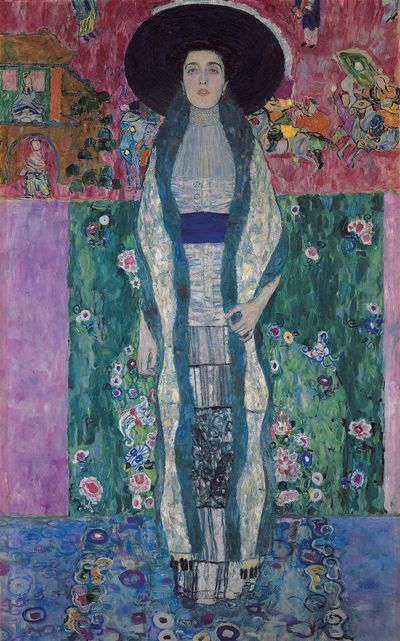
Gustav Klimt (1862-1918)
Portrait of Adele Bloch-Bauer II, 1912
Oil on canvas: 75 in. x 47 in.
Bloomberg’s Katya Kazakina reports that last year billionaire media mogul Oprah Winfrey sold Gustav Klimt’s Portrait of Adele Bloch-Bauer II to a Chinese buyer for $150 million in a sale brokered by mega-dealer Larry Gagosian. Winfrey purchased the painting for $87.9 million in 2006 at Christie’s in New York.
According to the article:
In 2014, Winfrey lent the painting anonymously to the Museum of Modern Art for five years, according to the person, who asked not to be identified because the information is confidential. The loan was arranged by entertainment mogul David Geffen, who is Winfrey’s friend and a benefactor of the museum, the person said.
Gagosian contacted Winfrey through Geffen.
The article also notes:
The work is the second major Klimt that changed hands since the art market started contracting. Russian billionaire Dmitry Rybolovlev sold “Water Serpents II” (1904-1907) privately for $170 million in November 2015, according to Sandy Heller, Rybolovlev’s art consultant. Both Klimts went to Asia, where booming wealth has built a growing network of collectors eager to anchor their art holdings with Western masterpieces.
“Klimt is on the list of some people,” said Grace Rong Li, who advises Asian collectors on Western modern and contemporary art. The appeal of the artist, known for his golden-hued “The Kiss,” is both aesthetic and financial, she added.
“Portrait of Adele Bloch-Bauer II,” from 1912, depicts a woman in a long, narrow robe and halo-like black hat, standing against an ornate background of mauve and green. The subject, Bloch-Bauer, was the wife of a Jewish industrialist and art patron in Vienna.
For Sweden, three oil sketches of the Roman countryside by Simon Denis and Pierre Henri de Valenciennes

Simon Denis (Antwerp 1755-1813 Naples)
The Waterfall in Neptune’s Grotto at Tivoli, c 1790
Oil on paper: 9 ¾ x 7 7/8 in.
Click on image to enlarge
Sweden’s Nationalmuseum has acquired three oil sketches by pioneers of en plein air painting Simon Denis and Pierre Henri de Valenciennes. Denis’ The Waterfall in Neptune’s Grotto at Tivoli and Valenciennes’ View of the Roman Campagna near Subiaco were purchased at Christie’s September 14, 2016 sale in Paris of Old Masters. The Denis, estimated at €12,000-18,000, sold for a total of €15,000 (including fees, or $16,865), while the Valenciennes, estimated at €25,000-35,000, soared to a hefty €163,500 (including fees, or $183,833). Both were sold off by from the Minorca Collection. Another work by Denis, Study of the Roman Campagna, was purchased from the Aaron Gallery in New York.

Pierre Henri de Valenciennes (Toulouse 1750-1819 Paris)
View of the Roman Campagna near Subiaco, c. 1782
Oil on paper: 12 7/8 x 19 in.
Click on image to enlarge
The museum published the following on its website announcing the acquisition:
Views of Rome and the surrounding countryside have a distinguished pedigree. For a long time, they remained true to the 17th-century landscape ideal and were painted in the studio. Valenciennes and Denis broke new ground by making sketches in oil, often on paper, on location. The light and weather conditions were as important as the subject, so the works were produced quickly. Despite being preparatory studies, these oil sketches laid the foundations for much of the 19th century’s plein air painting.
Pierre Henri de Valenciennes (1750–1819) is considered a pioneer who had a major influence on French art as both a theorist and a teacher. He was elected to the academy of fine arts in Paris in 1787, and served as professor of perspective theory from 1812 onward. Élémens de perspective pratique à l’usage des artistes (1800), his treatise on practical landscape painting with a focus on perspective, was particularly significant. Eventually his efforts led the academy to establish a dedicated prize for historical landscape painting.
The recently acquired view of Subiaco near Rome shows Valenciennes’ skill in capturing the lighting conditions and cloud shadows through brushwork that is both sensitive and vivid. The painting depicts the movement of the wind and its effects rather more than the landscape itself. Oil sketches of this kind, painted on location, differ radically from the works Valenciennes created in his studio. The latter portray an idealised version of nature, with scenes from classical mythology, but thanks to the introduction of oil sketches to the process, the lighting and colouring are markedly different from those seen in 17th-century landscape painting.

Simon Denis (Antwerp 1755-1813 Naples)
Study of the Roman Campagna, c 1800.
Oil on paper.
Click on image to enlarge
Simon Denis (1755–1813), a native of Antwerp, travelled via Paris to Italy, where he stayed for the rest of his life. Long overlooked, Denis was rediscovered in 1992 when a large number of his oil sketches were put up for sale. These had been passed down through generations of the artist’s descendants, so had stayed out of the public eye. His technique is reminiscent of Valenciennes, with similarly economical brushwork and a focus on the lighting and weather conditions. Unlike the idealised landscapes, the oil sketches portray nature as changeable, which the recently acquired pieces exemplify superbly. The view of the Roman Campagna in particular shows Denis’ skill in capturing atmospheric phenomena with great simplicity. The results are magnificent and the effect almost illusory.
The smaller oil sketch depicts Neptune’s Grotto at Tivoli. With masterful simplicity, Denis captures the play of light in the waterfall and the foliage in the foreground contrasted with the dark cliff. The work appears to have been painted in haste, with thinly applied colours that dried rapidly, allowing the artist to move on to the next layer. A crouching figure at lower right serves to illustrate the scale of the subject.
When Nationalmuseum reopens after renovations, these three new acquisitions will enable the museum to better chart the beginnings of plein air painting. This would not have been possible without the generous support of the Wiros Fund, the Sophia Giesecke Fund, and the Hedda and N D Qvist Memorial Fund. Nationalmuseum has no budget of its own for new acquisitions, but relies on gifting and financial support from private funds and foundations to enhance its collections of fine art and craft.
An important Salomon van Ruysdael for the Stedelijk Museum, Alkmaar

Salomon van Ruysdael (Dutch, Naarden, born ca. 1600–1603, died 1670 Haarlem)
A View of Alkmaar with the Sint Laurenskerk from the North
Signed and dated on the boat lower right: S. VRUYSDAEL. 1644 (VR in ligature)
Oil on panel, 241⁄4 x 363⁄4 ins. (61.6 x 93.4 cm)
Alkmaar, Stedelijk Museum
Click on image to enlarge.
The Stedelijk Museum, Alkmaar in The Netherlands, has acquired Salomon van Ruysdael’s A View of Alkmaar with the Sint Laurenskerk from the North of 1644, the earliest of several scenes the artist painted of the town. The oil on panel was acquired from an American private collection, and is the first of the Van Ruysdael Alkmaar paintings in a Dutch public collection.
According to the museum’s website, the artist had a special relationship with Alkmaar. His brother Pieter de Gooyer lived there with his family. Van Ruysdael frequently stayed in the city, especially after Peter was deceased and Salomon became guardian of his children.
The acquisition was made possible by contributions from the King Baudouin Foundation United States, the Rembrandt Association, BankGiro Lottery Acquisition Fund, Mondriaan Foundation, the VSB, Victory Fund Alkmaar, Alkmaar and the Stedelijk Museum Alkmaar Friends.
The painting had been with London-based art Old Master painting dealer Johnny van Haeften, whose website has the following description of the painting:
Between the years 1644 and 1664, Ruysdael painted seven landscapes with the city of Alkmaar, six of which are recorded in Stechow in his 1975 monograph on the artist-i. The present work, which appears to be the earliest and one of the most accurate views of the city, was not known to him. It appeared on the art market in 1987 and has since been universally accepted as an autograph work. However, the two figures and the basket in the foreground lower left, visible in the 1987 catalogue illustration, proved to be nineteenth-century additions and have since been removed.
The city of Alkmaar is only about 35 kilometres from Haarlem, and Ruysdael is known to have been there in 1644, as his brother, Pieter de Goyer, was buried in the Grote Kerk (Sint Laurenskerk) on 28 January 1644. Ruysdael shows the city from the north, the church dominating all other buildings-ii. Its choir is to the left and the nave to the right, while the long transept stretches out towards the viewer. Immediately to the right of the transept is an odd bulbous shape, which reveals itself as a family of storks nesting in the bell tower of a now- destroyed monastery. The orientation here is the same as the Dublin painting of Alkmaar with the Grote Kerk, Winter (Stechow 21), dated 1647-iii. The Dublin picture at first looks quite different from A View of Alkmaar with the Sint Laurenskerk from the North because of the change in season. The presence of the frozen river, with its crowds of skaters and the large sledges in the foreground, masks the fact that the basic geography is the same – even the imaginary course of the river in the foreground. However, the View of the Town of Alkmaar, in the Metropolitan Museum (Stechow 401) is far closer in feeling. There Ruysdael shows the church from the west, so that we see the nave of the church coming towards us. In the foreground is a similar lazy river landscape, though with a ferryboat replacing the fishermen.
A View of Alkmaar with the Sint Laurenskerk from the North is characteristic of Ruysdael’s paintings of the mid-1640s. Here he has left behind his tonal phase, when he was strongly under the influence of Jan van Goyen, and has moved to a more majestic depiction of the Dutch landscape. His palette is richer and more varied, with deeper blues in the sky and touches of local colour in the foreground figures and the sails. Ruysdael uses a traditional compositional device to create a sense of spatial recession: the long thin triangle of shore that moves from middle ground to the distant right. This is energised by the more dramatic falling line of the treetops, anchored at the centre by the large mass of the church, which dwarfs the surrounding buildings. He peoples the foreground with fishermen and their baskets and nets and scatters the the smaller silhouettes of waterfowl among them. The present work is a combination of historical accuracy and imagination that vividly evokes the landscape and mood of seventeenth-century Holland.
Salomon Jacobsz. van Ruysdael was born in Naarden around 1600, the son of a cabinet maker from Gooiland, Jacob Jansz. de Goyer. Early in his life, Salomon used his father’s name but later he and his brother Isaack adopted the name Ruysdael, probably derived from the country manor, Ruisschendael near Blaricum, their father’s home town. Despite the difference in spelling, it is the same family as the artist’s famous nephew, Jacob van Ruisdael. Shortly after their father’s death in 1616, Salomon and Isaack, who was also a painter, frame maker and art dealer, moved to Haarlem. Salomon entered the city’s St. Luke’s Guild in 1623 and lived there for the rest of his life. His earliest known landscape is dated 1626 and he was praised as a landscape painter as early as 1628 by Samuel van Ampzing-iv. In 1647 and 1669 he served as an officer of the St. Luke’s Guild and, in 1648, was made dean. In 1651, Ruysdael was recorded as a merchant dealing in blue dye for Haarlem’s bleacheries. Although he lived most of his life in Haarlem, he appears to have travelled widely in The Netherlands and his paintings include views of Dordrecht, Utrecht, Arnhem, Alkmaar and Rhenen. He was buried in St. Bavo’s Church in Haarlem in 1670.
i W. Stechow, Salomon van Ruysdael, eine Einfuhrung in seine Kunst, 2nd (revised) edition, Berlin 1975, cat. no. 9, 1656, London art market 1957; cat. no. 21, 1647, Dublin, National Gallery of Ireland; cat. no. 401, datable to mid-1650s, New York, Metropolitan Museum of Art; cat. no. 523B, 1651, Longleat, The Marquis of Bath; cat. no. 535, 1664, New York, Private Collection; cat. no. 545, Rheden, F. H. Fentener van Vlissingen.
ii See. W. Liedtke, Dutch Paintings in the Metropolitan Museum of Art, New York, New Haven and London, 2007, vol. 2, pp. 812-814, under cat. no. 187, for a discussion of the orientation of the church and the geography of the city.
iii The signature and date are not recorded by Stechow but were revealed in cleaning. See: H. Potterton, Dutch Seventeenth and Eighteenth Century Painting in the National Gallery of Ireland. A Complete Catalogue, Dublin 1986, p. 138, cat. no. 27.
iv Samuel Ampzing, Beschrijving ende lof der stad Haerlem in Holland, Haarlem, 1628.
Other Alkmaar paintings can be found at New York’s Metropolitan Museum of Art, where it is part of the founding collection of 1871 (below).

Salomon van Ruysdael (Dutch, Naarden, born ca. 1600–1603, died 1670 Haarlem)
View of the Town of Alkmaar
Oil on panel: 20 1/4 x 33 in. (51.4 x 83.8 cm)
Click on image to enlarge.
And, the Museo Thyssen-Bornemisza in Madrid, Spain (below).

Salomon van Ruysdael (Dutch, Naarden, born ca. 1600–1603, died 1670 Haarlem)
View of Alkmaar, ca. 1650
Oil on panel: 36.2 x 32.5 cm
Click on image to enlarge
Rediscovered Andrea del Sarto (self) portrait drawing makes €3.2million

Portrait of a Middle-Aged Man, Andrea d’Angiolo, called Andrea del Sarto (1486-1530)
Red and black chalk on paper: 9 x 7 inches
Click on image to enlarge
A red and black chalk drawing by the Italian artist known as Andrea del Sarto and last seen publicly at a sale on July 1, 1833, was sold for a €3.2million on December 17, 2016 at Gestas & Carrère in Pau, a record price for an Old Master drawing at auction in France. According to the Antiques Trade Gazette, the drawing, recently rediscovered in a private collection and which carried a €500,000-600,000 pre-sale estimate, is going to an American collection. The report did not specify if it was a public institution or a private buyer.
What makes this story even more interesting is that the drawing may actually be a self portrait. According to the Gazette:
The bearded man depicted in the drawing also appears three major works completed by del Sarto in the 1520s: the Panciatichi Assumption c.1523 and the Passerini Assumption c.1526 (both now housed in the Pitti Palace, Florence) and the Borgherini Holy Family c.1529 in the Metropolitan Museum, New York.
In his two-volume biography of 1965, the British art historian John Shearman suggested the character assuming this distinctive posture and expression may well be a self-portrait of Andrea del Sarto himself.
Although disputed, the theory gains weight with a passage from Giorgio Vasari’s Lives regarding the Panciatichi altarpiece. It reads: “Among the apostles Andrea made his self-portrait, it seems so natural, living”.
The discovery in Pau represents a significant addition to the artist’s oeuvre. Less than 200 drawings by del Sarto survive with most in major museums (80 are in the Uffizi while the Louvre has 40).
Less than 10 autograph drawings are known to reside in private collections. The last on the market was the red and black chalk head of Saint Joseph, a preparatory drawing for the Bracci altarpiece with subsidiary studies c.1526-27, that sold for a premium-inclusive £6.5m at Christie’s London in 2005.
While the €3.2m sum represents the highest price for an Old Master drawing at a French auction, the record could well be surpassed in June next year when Paris saleroom Tajan offer a study of the martyrdom of Saint Sebastian which has been attributed to Leonardo da Vinci.

These interior wooden panels, featuring Adam and Eve (holding a citrus fruit), and the iconic “The Adoration of the Mystic Lamb,” have yet to be restored. For many years, the inside panels were only displayed on feast days.
Click on image to enlarge.
The Ghent Altarpiece, the 15th century polyptych by the Flemish brothers Jan and Hubert Van Eyck, is one of the most impressive, influential, and enigmatic paintings produced in the West, and one with a colorful history. A multi-year restoration project has revealed new secrets about the nearly six hundred year old masterpiece, according to a fascinating article in the New York Times.
Of the painting’s iconography, the article notes:
[T]he altarpiece is widely recognized as one of history’s most influential art works, because of the intimate attention it gives to both earthly and divine beauty. The polyptych altarpiece, consisting of 12 panels, has at its center its most iconic panel, “The Adoration of the Mystic Lamb.’’ It depicts a liturgy attended by different groups of people in a landscape rich in religious symbolism. In the middle is a white lamb on an altar, with a breast wound gushing blood.
On the lower outer panels, people look on — some more interested than others. The upper register portrays three enthroned figures: In the middle might be God or Christ — experts are not sure — flanked by the Virgin Mary on the left and John the Baptist on the right.
On the upper outer panels, angels sing and play music. Adam and Eve, in one of the earliest renderings of them naked with fig leaves, stand on the outermost wings. The upper outside register represents scenes from the Annunciation of Mary and the lower register has sculptures of St. John the Baptist and St. John the Evangelist.
Visitors to Ghent today see parts of the altarpiece in a special room at St. Bavo Cathedral, for which it was commissioned, and the Museum of Fine Arts, where the restoration efforts can be observed through a glass wall. Read the Times story about the new scanning technologies that have allowed restorers to go below centuries of old overpainting and layers of varnish to see the original paint layers, and other developments. But, by all means, go to Ghent and see this incomparable painting – one of the great art experiences to be had.
A Ribera for San Diego

Saint James the Lesser (ca. 1632) by Jusepe de Ribera.
The San Diego Museum of Art is proud to announce the acquisition of Saint James the Lesser (ca. 1632) by Jusepe de Ribera. This 17th-century work by the renowned Spanish Baroque master builds on the Museum’s prestigious collection of Spanish art. The painting is currently on display in the European galleries alongside other masterpieces in the collection by Francisco de Zurbarán, Bartolomé Esteban Murillo, and El Greco.
Considered the first great Old Master of the Spanish Baroque, Jusepe de Ribera is known for his detailed, unflinchingly hyperrealistic depictions of the human body.
Born in Spain, Ribera moved to Italy seeking prominence as a young artist. Known for signing his paintings “Jusepe de Ribera, español,” Ribera used his nationality as a marketing tool to connect to wealthy Spanish patrons in Naples; this is also what led to his nickname “Lo Spagnoletto” or “little Spaniard.” It was in Italy where Ribera secured his fame and produced his most legendary works, including Saint James the Lesser. Several large religious institutions commissioned works from him, including the Certosa di San Martino.
“Since the inception of this institution, The San Diego Museum of Art has had a deep connection to Spanish art and we’re delighted to welcome Jusepe De Ribera’s Saint James the Lesser into the permanent collection,” said Roxana Velásquez, Maruja Baldwin Executive Director of The San Diego Museum of Art. “The work is a significant addition to the Museum’s collection, and further contributes to the recognition of our collection of Spanish holdings as among the finest in the world.”
Michael Brown, Ph.D., the associate curator of European Art at The San Diego Museum of Art, said “Ribera was one of the most innovative artists of his day, a true pioneer of a new realistic approach to painting. His scenes connect so powerfully because he depicted a recognizable world – his saints look as though they’ve been plucked from the gritty streets of Naples.”
This life-sized representation of Saint James shows him gazing upward and holding an excerpt of the Apostles’ Creed. The piece features dramatic lighting and intense highlights, characteristics of Ribera’s best works. This saint was a particular favorite of Ribera’s, as was the recognizable model, who appears in other works by Ribera, which are on display across the globe including at the Thyssen-Bornemisza and The Prado, both in Madrid, Spain.
The work’s quality is on par with those found at the world’s finest museums, including the Louvre, the National Gallery, and the Metropolitan Museum of Art, and will be the singular painting by Ribera in the Museum’s permanent collection.
Spanning the centuries from the Renaissance to Post-Impressionism, the Museum is acclaimed for its collection of Spanish masterpieces. The façade of the Museum itself includes life-sized sculptures of Murillo, Zurbarán, and Diego Velázquez as well as reliefs in tondo of Ribera and El Greco. The Museum now has paintings within its collection from each of the artists on the façade, except for Velázquez.
Purchased by the Museum from Rafael Valls, LTD and Helena Mola, Ribera’s Saint James the Lesser joins the collection following the recent acquisitions of Sorolla’s By the Seashore, Valencia, Zurbarán’s Saint Francis in Prayer in a Grotto, and Pedro de Mena’s San Diego de Alcalá, a Spanish baroque sculpture. These works now complement an impressive collection of art by Francisco de Goya, El Greco, Sánchez Cotán, Valdés Leal and more.
Is this a real Caravaggio worth more than $130 million?

French painting expert Eric Turquin speaks on April 12, 2016 in Paris in front of the painting entitled “Judith cutting off the head of Holofernes”, presented as being painted by Italian artist Caravaggio (1571-1610), while experts are still to determine its authenticity. The painting was found out in an attic of a house near Toulouse, southwestern France. PATRICK KOVARIK / AFP.
Click on image to enlarge.
The discovery of a “new” Caravaggio painting is bound to be both newsworthy and controversial, and the unveiling of a Judith cutting of the head of Holofernes at Milan’s Pinacoteca di Brera is both. The painting, dated to 1606-07, was discovered in the attic of a house near Toulouse, France, in 2014. Not only is the attribution contested, but the painting’s exhibition at the museum has resulted in one of its advisory board members to resign in protest over the commercialization of the enterprise.
Caravaggio discoveries are rare but not unusual. The last major discovery was in 1991 with The Taking of Christ now at the National Gallery of Ireland. Another version of Judith Beheading Holofernes was discovered in the 1950s and is now at the Palazzo Barberini in Rome.

Caravaggio, Judith Beheading Holofernes, 1598-99, Palazzo Barberini.
According to the Art Newspaper, the new discovery now on view at the Brera:
[W]ill be displayed alongside the institution’s Caravaggio masterpiece, the Supper at Emmaus (1605-06), a copy of Caravaggio’s Magdalen in Ecstasy (after 1610) and three works by the painter’s Flemish follower Louis Finson. The exhibition Caravaggio: a Question of Attribution (10 November-5 February), part of the museum’s “dialogues” series pairing works from its collection with key loans, will offer both art historians and the general public a unique opportunity to assess the controversial attribution for themselves, says the director James Bradburne.
The initiative, organised by the Caravaggio specialist and former director of the Museo di Capodimonte in Naples, Nicola Spinosa, has already divided experts. On 25 October, the art historian Giovanni Agosti resigned from Brera’s advisory committee in protest against the “uncritical” presentation of a painting that is “not only private property but for sale”. The work, which was discovered in 2014 by a French family who wanted to fix their leaky roof, was entrusted to Eric Turquin, a Parisian Old Master dealer who claims it could be worth €120m. “Brera is a museum of the Italian state, not a commercial gallery or a banking foundation. Presenting a painting in its rooms automatically confers authority on it,” Agosti wrote in a letter to Bradburne.
At the heart of the debate is the labelling of the work as a Caravaggio in the wall texts and exhibition catalogue. A museum “should not accept the conditions of a lender, especially if the lender is appointed to sell the painting”, Agosti says. The French Judith will be shown with a “clear disclaimer” that the attribution comes from the owner and not the museum, Bradburne tells The Art Newspaper. “There is no ambiguity about the uncertainties surrounding the painting.”
Technical research has so far proved inconclusive. The French culture ministry declared the work a national treasure in March, placing it under an export ban for 30 months while the Musée du Louvre conducts further study and the government considers whether to make an offer to buy it. Spinosa was among the Caravaggio scholars invited by Turquin to examine the painting, identifying it in his written evaluation as a lost original last documented in the early 1600s “even if we do not have any tangible or irrefutable proof”. Another expert, Mina Gregori, believes the work to be a copy by Finson, who is recorded as owning the lost Judith between 1607 and his death in 1617.
Louis Finson’s copy of Caravaggio’s lost original, Judith Beheading Holofernes (around 1607), from the Intesa Sanpaolo bank collection (Image: Luciano Pedicini / courtesy of the Pinacoteca di Brera) The disputed Caravaggio: Judith Beheading Holofernes (1606-07), currently in the guardianship of the French ministry of culture (Image: courtesy of the Pinacoteca di Brera)
The exhibition will include an almost identical composition dated to 1607 and attributed to Finson, on loan from the Intesa Sanpaolo bank in Naples. However, the Galleria Nazionale d’Arte Antica at Palazzo Barberini in Rome refused to lend the accepted, earlier version of Caravaggio’s Judith Beheading Holofernes (around 1598-99), La Repubblica reports. “I do not believe that it would have made sense to exhibit the Barberini Judith alongside the one found in France… From photographs it looks like a beautiful picture, but it is a Neapolitan prototype,” the director Flaminia Gennari Santori told the Italian newspaper.
Bradburne maintains that: “it is not the job of a museum to confirm the attribution of the paintings it borrows, only to decide firstly if the painting is necessary for the thesis of its exhibition, in this case ‘A question of attribution’ and secondly if it is of a quality that warrants being shown in a museum, which in this case—whether it is a Caravaggio or not—it certainly is.” While he concedes that museums can influence the market, Bradburne says the “only risk” in showing the French Judith is for the owner “if it does not garner the consensus of the experts”. The museum is due to host a day-long seminar with leading Caravaggio scholars before the end of January 2017.

German museum acquires study for masterpiece destroyed in WWII
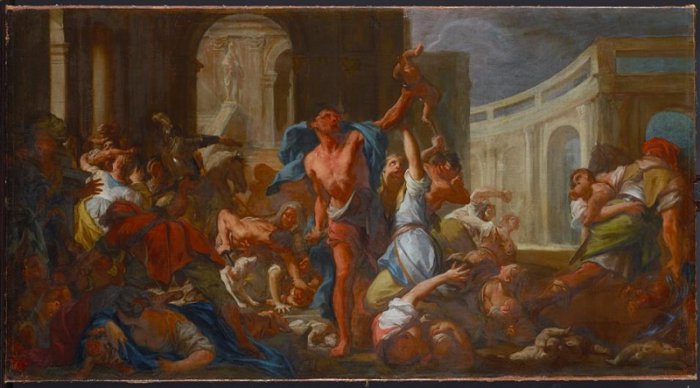
Francesco Trevisani, Massacre of the Innocents (study), around 1714, oil on canvas: 75 x 136 cm, Gemäldegalerie Alte Meister, Staatliche Kunstsammlungen Dresden, DLN Nr. 2016/2; 2016 gift from Karen S. W. Friedman, Edward A. Friedman, Kristin Friedman, Theodore N. Mirvis, Ruth Mirvis, Gary D. Friedman, Darcy Bradbury and Eric Seiler through the “Friends of Dresden” in New York City.
A study for an early 18th century painting destroyed in 1945 during World War II has been acquired by the Gemäldegalerie Alte Meister (Old Masters Picture Gallery) at Staatliche Kunstsammlungen Dresden. The final version of Francesco Trevisani’s (1656-1746) Massacre of the Innocents had been at the museum in Dresden for more than 200 years before it was incinerated. The new acquisition is the only known study.

Francesco Trevisani, Massacre of the Innocents, around 1714, oil on canvas: 250 x 464 cm, Gemäldegalerie Alte Meister, Staatliche Kunstsammlungen Dresden, gallery no. 445, destroyed by fire in 1945 in Dresden.
According to the museum’s announcement:
Francesco Trevisani is considered one of the central Roman Baroque painters of the first half of the 18th century. He created the “Massacre of the Innocents” in around 1714 for Cardinal Pietro Ottoboni (1667–1740), one of the most influential and innovative art patrons of the time.
Before the artist painted the subject onto the huge canvas, more than four and a half metres wide, he painted the oil study (“bozzetto” in Italian) in preparation. The impressive dimensions of this study (75 x 136 cm) indicate that the draft was also presented to the client to give him an initial idea of its composition and colour scheme.
Trevisani’s “Massacre of the Innocents” was part of a cycle on Jesus’ childhood which Ottoboni probably commissioned to mark the 25th anniversary of his appointment as a cardinal and vice-chancellor of the Holy Roman church. Four artists worked on the cycle, which originally comprised eight paintings. Of the five works from the cycle still known today, four were purchased in 1743 by Augustus III, Prince Elector of Saxony and King of Poland, for his collection of paintings in Dresden. As well as the “Massacre of the Innocents”, the other paintings are “The Three Magi in front of Herod” by Sebastiano Conca, “The Adoration of the Magi” by Giuseppe Bartolomeo Chiari and “Rest on the Flight into Egypt” by Francesco Trevisani, all three of which are still in the Gemäldegalerie Alte Meister.
The emotion-laden rhetoric of the imagery is typical of Late Baroque painting. Trevisani places the figures as if they are on a stage, giving them passionate gestures and facial expressions. He uses this rhetorical repertoire to portray the scene described in the Gospel according to St. Matthew when baby sons were massacred on the orders of King Herod immediately after Jesus’ birth (Matthew 2:16). Herod wanted to do away with the new-born king of the Jews, Jesus of Nazareth, his putative rival.
Darcy Bradbury, representing the donators, commented, “We are very pleased to bring this important work to the City of Dresden. The subject matter of our painting is tragic, and the destruction of the original masterpiece in the last, terrible weeks of World War II was also tragic, a reminder of the terrible human consequences of war. Dr. Blobel, a Nobel prize winning scientist and founder of “Friends of Dresden”, who contributed his entire Nobel prize award to the restoration of Dresden, was protected as a young child by some kind and courageous citizens of Saxony from the worst consequences of war. As American Jews, that story spoke to us so deeply. By giving this painting to the people of Dresden, we hope that it can remind all of us of the both the terrible and beautiful things that humankind can do. “.
Marion Ackermann, Director General of Staatliche Kunstsammlungen Dresden, announced, “We are very grateful to the donators in the USA for this generous gift. This study will give our visitors a specific impression, for the first time, of the appearance of this large-scale painting by the Roman artist before it was destroyed in 1945. I would like to thank the donators Karen S. W. Friedman, Edward A. Friedman, Kristin Friedman, Gary D. Friedman, Theodore N. Mirvis, Ruth Mirvis, Darcy Bradbury and Eric Seiler on behalf of Staatliche Kunstsammlungen Dresden. The “Friends of Dresden” association (New York City) made the organisational aspects of this donation possible, for which we would also like to thank Günter Blobel.”

Lot 16. Caspar Netscher (?Heidelberg 1639-1684 The Hague) Woman feeding a parrot
signed and dated ‘CNetscher. Ao. 16.66.’ (CN linked) (lower left)
oil on panel: 18 1/8 x 14 5/8 in. (46 x 37 cm.)
Estimate: $2-3 million. This lot sold for a hammer price of $4.4 million ($5,093,000 with the buyer’s premium).
Click on image to enlarge.
ANOTHER POST SALE UPDATE: The National Gallery of Art in Washington, DC has acquired the Casper Netscher featured in this sale, according to the Washington Post.
POST SALE UPDATE: Today’s sale brought in $17,932,000 (this total includes the buyer’s fees), with 83 of 111 lots selling. A decent opening for the group of paintings restituted to the heirs of Hans Ludwig Larsen with eight of the eleven selling – bidding in the room, the buyer of lot 6 (below) the van Goyen skating scene also picked up lot 3, a Wouvermann landscape, and lot 4, a Berchem landscape. The star lot, the Caspar Netscher, opened at $1 million, moved steadily to $3 million, then progressed at a slightly slower pace selling to an “Anonymous” bidder, as the sale results noted, for a hammer price of $4.4 million ($5,093,000), a world record for the artist. One telephone bidder (listed on the sale results as a “European Institution”) picked up lot 1, a Teniers peasant scene, lot 5, the small Brueghel (below), lot 8, the van Orley (below), lot 9, the Master of the Antwerp Adoration (below), lot 12, a Teniers Adam and Eve that soared past its $300,000 high estimate to hammer at $700,000 ($845,000 with the buyer’s premium), lot 13, another Teniers, lot 15, a Pieter Brueghel the Younger Payment of Tithes, that easily surpassed its $800,000 high estimate to hammer at $1.4 million ($1,685,000 with the buyer’s premium), and lot 22, a Studio of Rubens portrait.
Other notable sales include lot 38, a Ruisdael Dunes by the Sea, which sold for 2-1/2 times its $600,000 high estimate to hammer at $1.5 million ($1,805,000 with fees), and lot 69, a Frans Francken II Temptation of Saint Anthony that went for five times its $30,000 high estimate to hammer at $150,000 ($185,000 with fees).
ORIGINAL POST: This elegant “Woman feeding a parrot was, until recently, among the most celebrated treasures of the Von der Heydt Museum in Wuppertal, recognized for decades as one of Caspar Netscher’s greatest paintings and one of the undisputed icons of Dutch genre painting of the Golden Age,” according to the catalogue notes for this lot in Christie’s June 4, 2014, sale of Old Master Paintings in NewYork. Restitution of works looted by the Nazis during World War II is an ongoing process and has brought to sale many works previously thought permanently off the market. No doubt there will be more. This work was restituted to the heirs of Hugo and Elisabeth Andriesse.
Of this lot, Christie’s notes:
Best-known today as a painter of exquisite, highly finished domestic interiors, Caspar Netscher in fact produced surprisingly few before abandoning the genre altogether around 1670 for the more lucrative field of portraiture. A Dutch painter of German origin, Netscher was probably born in Heidelberg in 1639. He trained first in Arnhem under Hendrik Coster, a little known still-life and portrait painter, before moving in 1654 to Deventer, where he entered the workshop of the greatest genre painter of the day, Gerard ter Borch. Netscher quickly learned Ter Borch’s technique of rendering the texture of costly materials, and he is known to have made very successful copies of his master’s most recent works: a signed copy of Ter Borch’s Parental Admonition (1654; Rijksmuseum, Amsterdam), dated 1655, is in Schloss Friedenstein, Gotha, for example. That such works were allowed to be fully signed by Netscher suggests the special place he held in his master’s studio.
[…]
As [Marjorie] Wieseman [author of the catalogue raisonné of the artist’s paintings] observes, the birds were often associated with luxury and sensuality, and “their central role in scenes of women holding or feeding parrots hints at amorous or erotic elements.” Moreover, she adds, “a bird freed from its cage – in Netscher’s painting, lured away with a bit of sweet – was often a symbol of lost virginity, and was associated with an invitation to amorous dalliance,” a reading that seems hard to dispute in light of our young lady’s coquettish but bold and inviting gaze. Interestingly, Wayne Franits has cited instances in which “the presence of parrots…signifies the proper training of their mistresses.”
A superb preparatory drawing for the painting, in pen and bistre wash over black chalk underdrawing, is in the British Museum … The drawing, which was in the collection of Gabriel Huquier in Paris in the 18th century, is fully signed and dated 1666. Like his teacher Ter Borch, Netscher was an active draftsman and about 45 sheets from his hand survive. As with the study for Woman feeding a parrot, most of his drawings are modelli or compositional designs.

Lot 5. Pieter Brueghel II (Brussels 1564/5-1637/8 Antwerp) Peasants in an open wagon
oil on panel: 4½ x 9½ in. (11.5 x 24 cm.)
Estimate: $300,000-500,000. This lot sold for a hammer price of $550,000 ($665,000 with the buyer’s premium).
Click on image to enlarge.
This delightful rendering of a raucous carriage ride was also recently restituted, in this case to the heirs of Hans Ludwig Larsen, having been in the Stichting Nederlandsch Kunstbezit, The Netherlands, since January 15, 1946. From the lot notes:
This charming scene, showing a group of rowdy peasants en route to a wedding celebration, exemplifies the lighthearted and often humorous observations of everyday life for which Pieter Brueghel II was – and remains – renowned. Even in its small size, this vignette reveals a wealth of anecdotal detail: seven peasants have crowded into the rickety carriage, pressed together so that one at the front has to wrap his arms around his knees to fit inside, while the two nearest the viewer seem poised to fall backwards over the edge. At center, a particularly boisterous woman raises a wine jug high in the air, perhaps to keep it away from her obviously eager companion, who may have already had too much. Stumbling around the back of the cart, a man in a red cap with his back to the viewer rearranges the bridal gifts, aided by another fellow who moves a three-legged stool – a common motif in Brueghel’s paintings – out of the way. The cart, which might more usually have been drawn by a driver in an enclosed cab, is pulled by two sturdy horses that seem just to have felt the sting of their rider’s whip.
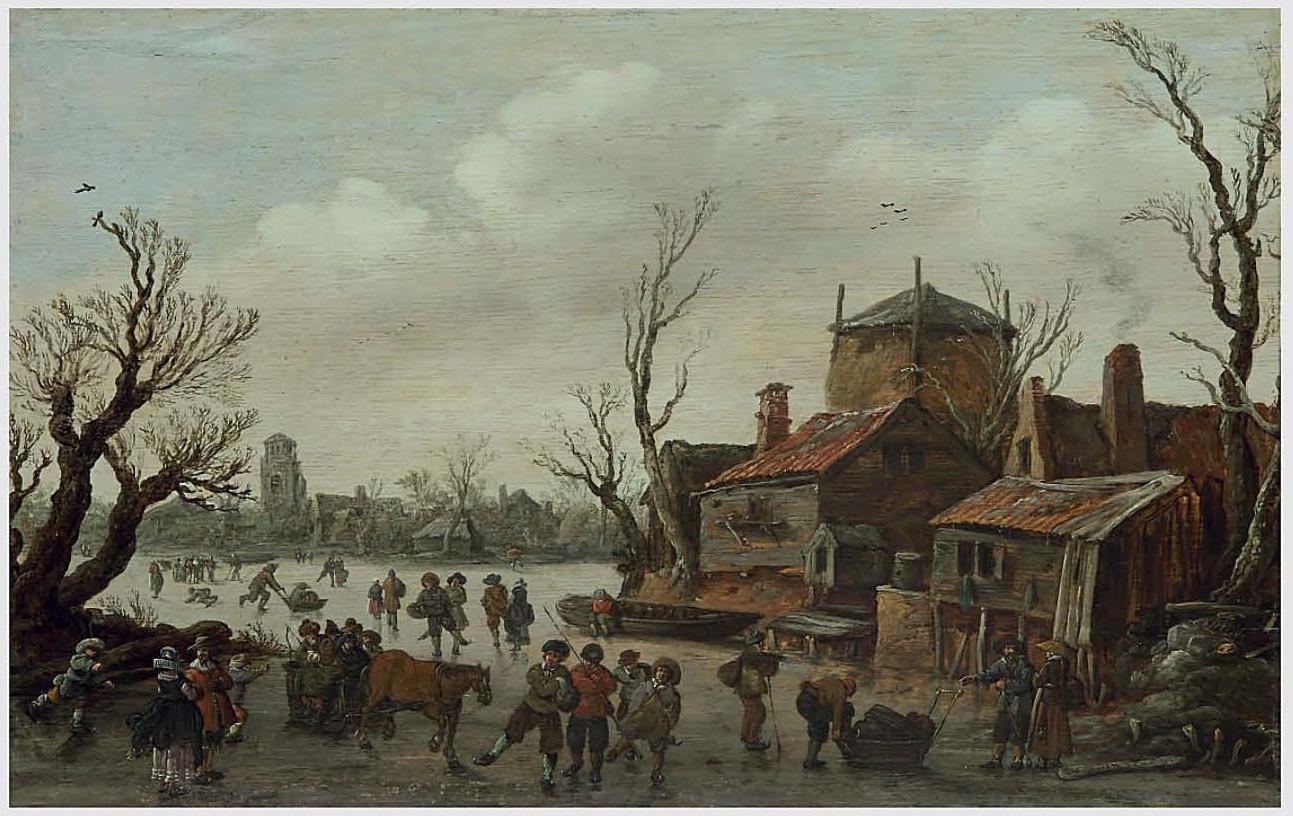
Lot 6. Jan Josefsz. van Goyen (Leiden 1596-1656 The Hague) A winter scene with skaters and a village beyond
signed and dated ‘I V GOIEN 1626’ (lower right), oil on panel: 12 5/8 x 19 7/8 in. (32 x 50.5 cm.)
Estimate: $400,000-600,000. This lot sold for a hammer price of $320,000 ($389,000 with the buyer’s premium).
Click on image to enlarge.
As with the previous lot, this work too was recently restituted to the heirs of Hans Ludwig Larsen, having also been in the collection of the the Stichting Nederlandsch Kunstbezit, The Netherlands, since July 8, 1946. From the catalogue:
Beginning in the mid-14th century and lasting through the mid-19th century, Northern Europe experienced extraordinarily cold and long winters, and relatively cool summers, a period of climatic change known as the “Little Ice Age”. The resulting snows and frozen waterways had a significant effect on everyday life. The Dutch quickly adapted, inventing a variety of winter activities which could provide outdoor amusement despite the bitter cold. By the 17th century, winter landscapes filled with frolicking figures such as the present panel had become a beloved staple of Dutch Golden Age painting.
Here, Van Goyen represents villagers skating on a frozen river beside a group of thatched houses. The town church is visible in the background, and charming vignettes abound. At far left, two children chase one another behind an elegantly dressed couple who may be their parents. Just to their right, four passengers huddle together for warmth inside a sleigh while the driver sits on the edge, watching his horse delicately negotiate its way across the ice. At right, another man bends over to adjust the straps on his skates, while at center, four men skate toward the viewer with varying levels of grace and skill. One of them rests a long, thin poll on his shoulder, which he could use both to keep his balance and to help himself out of the water if he should fall through the ice, a relatively common occurrence.

Llot 8. Studio of Bernard van Orley (Brussels c. 1488-1541) Christ on the Road to Calvary
oil on panel: 25¾ x 22 7/8 in. (65.5 x 58 cm.)
Estimate: $100,000-150,000. This lot sold for a hammer price of $260,000 ($317,00 with the buyer’s premium).
Click on image to enlarge.
This, too, was restituted to the Larsen heirs, having been in the Stichting Nederlandsch Kunstbezit, The Netherlands, since January 15, 1946; it was confiscated by the German authorities following the occupation of The Netherlands, after May 1940.
The painting’s authorship is in dispute, Max Friedländer considers it autograph, as did Ludwig Baldass in 1930. However, JD Farmer:
considered this painting to be the work of a clearly identifiable hand distinct from Van Orley, yet very close to him. This artist, whom he christened “The Brussels Master of 1520,” tends to paint his figures with idiosyncratic, at times awkward poses and may have led a small, independent workshop that produced paintings most reminiscent of Van Orley’s style of the late teens, while demonstrating a familiarity with the master’s work through the thirties. Farmer hypothesized that The Brussels Master of 1520 may have even been related to Van Orley, suggesting the artist’s brother, Evrard, as a plausible candidate.
Raphael’s Spasimo di Sicilia (Prado, Madrid) serves as the chief form of inspiration:
Indeed, there are strong parallels between this painting and Raphael’s design, which Van Orley would have encountered when its cartoon was sent to Brussels to be woven as a tapestry for Cardinal Bibbiana between 1516 and 1520. The most immediate source for the present painting, however, was surely Van Orley’s own interpretation of Raphael’s design as it appears in the Northern artist’s Christ Carrying the Cross cartoon, which he created for Margaret of Austria’s “square” Passion tapestries of c. 1520-1522 (Patrimonio Nacional, Madrid), and which was later rewoven for the Alba Passion tapestries of c. 1525-1528 (Museé Jacquemart-André, Paris). Van Orley also took inspiration from the work of Albrecht Dürer, with whom he was personally acquainted: in 1520, Van Orley hosted a dinner party with Dürer as his guest. As in Dürer’s Christ Carrying the Cross from the Large Passion prints of c. 1497-1500, in the present panel the main focus is not Christ’s interaction with the swooning Virgin, but rather the miracle of the Sudarium, the holy cloth held by St. Veronica.

Lot 9. The Master of the Antwerp Adoration (active Antwerp c. 1505-1530), The Holy Family in a garden
oil on panel, circular: 23 5/8 in. (60 cm.) diameter, an approximately 1/8 in. (0.4 cm.) addition to the upper edge
Estimate: $250,000-350,000. The estimate for this lot was revised down to $200,000-300,000. This lot sold for a hammer price of $140,000 ($173,000 with the buyer’s premium)
Click on image to enlarge.
Yet another work restituted to the Larsen heirs, having entered the Stichting Nederlandsch Kunstbezit, The Netherlands, on the same day as the previous lot, this painting was originally part of an altarpiece that was divided, with this panel cut down from it original rectangular format.
When conceiving this composition, The Master of the Antwerp Adoration was likely inspired by Albrecht Dürer’s print of The Sojourn of the Holy Family in Egypt … from the Life of the Virgin series, begun in 1500. As in Dürer’s woodcut, the Virgin sits in the foreground attended by angels and embroidering a garment on her lap. Also similar is the bearded Saint Joseph at her left, carving out a long piece of wood. In Dürer’s print, Joseph is surrounded by jovial putti who frolic about, picking up the shavings and placing them into a basket. In the Larsen painting, it is the Christ Child himself who assumes this role.
The Master of the Antwerp Adoration has incorporated symbolic imagery in the painting in a manner typical of Netherlandish art of this period. The fanciful architecture in the background, together with the dense wood and columned structure on the right, suggest that the Holy Family resides within a hortus conclusus, that is, an enclosed, sacred precinct dedicated to the Virgin. Two angels fill silver pitchers with water from an elegant fountain in the courtyard, which together with the garden itself symbolize the immaculate purity of the Virgin. This imagery derives from the Song of Solomon as interpreted by Saint Bernard, who read the biblical love poem as an ode to the Virgin as the Bride of Christ. By the time panel was painted, the juxtaposition of the fountain, or “well of living waters”, the enclosed garden, and the Virgin was well-established in Netherlandish art. Indeed, it appears in Jan van Eyck’s famousMadonna at the Fountain of 1439 (Koninklijk Museum voor Schone Kunsten, Antwerp). In the present Holy Family in a garden, a peacock appears in front of the fountain. An exotic bird of paradise, it would have been understood in the artist’s time as a symbol of Christ’s immortality and the Resurrection. The cross formed by Saint Joseph’s plank and the wooden board beneath it is in no way accidental, but rather deliberately refers to Christ’s Passion. Likewise, the pincer in the foreground alludes to the tool that was used to remove the nails from the Cross after Christ’s death. Thus, within this everyday scene of familial tranquility and harmony, The Master of the Antwerp Adoration subtly alludes to Christ’s future sacrifice, creating a beautiful composition that rewards prolonged contemplation.
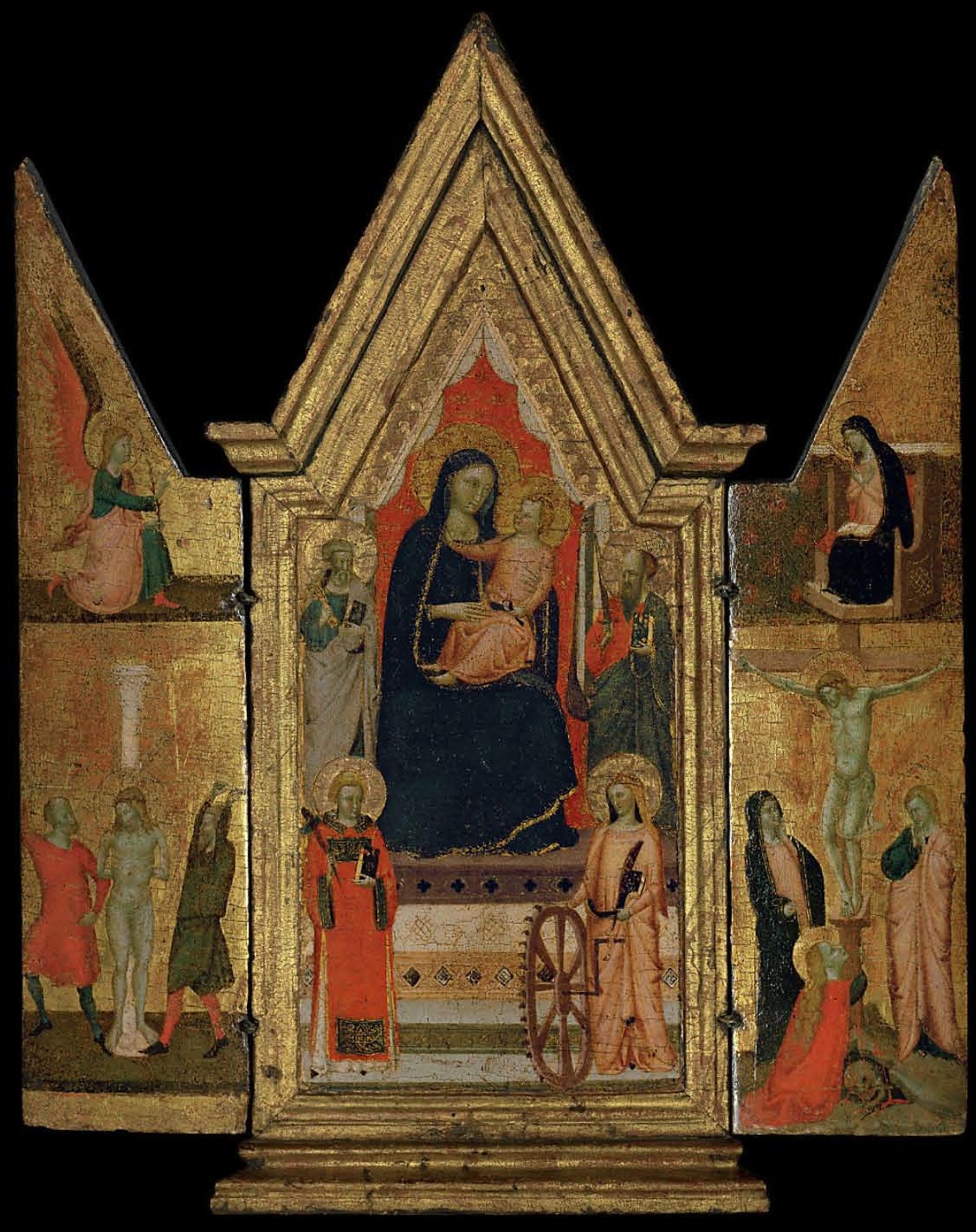
Lot 17. The Master of the Dominican Effigies (Florence, c. 1310-1350)
A triptych: central panel: The Madonna and Child Enthroned, with Saints Peter, Paul, Catherine of Alexandria and another Saint; the wings: The Flagellation of Christ; and The Crucifixion, with The Annunciation
tempera and gold on panel, in an integral tabernacle frame
open: 23 x 18 7/8 in. (59 x 47.9 cm.); closed: 23 x 10 7/8 in. (59 x 27.7 cm.)
Estimate: $200,000-300,000. This lot sold for a hammer price of $200,000 ($245,000 with the buyer’s premium).
Click on image to enlarge.
From the lot notes:
The anonymous artist known as the Master of the Dominican Effigies is named for a panel showing Christ and the Virgin with seventeen Dominican saints and beati, or “blessed ones”, now in the Archivio di Santa Maria Novella, Florence. Recent scholarship has improved our understanding of this previously understudied painter, who appears to have been one of the most important figures in Florentine manuscript illumination in the second quarter of the 14th century. The Master’s style, which blends the influences of artists from the prior generation – such as Lippo di Benivieni and the Master of San Martino alla Palma – also looks to the work of some of his slightly older contemporaries, such as Bernardo Daddi and Jacopo del Casentino, resulting in what Professor Laurence Kanter describes as “an animated and highly personal expression of his own” (see L. Kanter et al., Painting and Illumination in Early Renaissance Florence, New York, 1994, pp. 56-57).
[…]
The Master’s eponymous work can be dated to just after 1336 based on its inclusion of Maurice of Hungary, who had died that year, though the artist was certainly active well before then, probably from c. 1310. His last securely dated work is inscribed 1345, but a double-sided altarpiece in the Accademia, Florence (inv. 4633/4) may date to somewhat later. The present intimately-sized, portable triptych is a marvelous example of the miniaturist precision and narrative expression that characterizes the Master’s style. Datable to c. 1330, the triptych is a remarkable survival from an important phase of the artist’s career, showcasing his understanding of the achievements of Giotto and the founders of Tuscan painting.

Lot 29. Gerard ter Borch (Zwolle 1617-1681 Deventer)
A guardroom interior with a soldier blowing smoke in the face of his sleeping companion, a third looking on
oil on panel: 18½ x 14½ in. (47 x 36.8 cm.)
Estimate: $60,000-80,000. This lot sold for a hammer price of $170,000 ($209,000 with the buyer’s premium).
Click on image to enlarge.
This is a very entertaining genre picture is by the talented Gerard ter Borch. From the catalogue:
Likely originating in the work of Jacob Duck, the theme of a soldier being tickled awake was treated once more by Ter Borch in a composition dated to around 1656-1657 and now in the Taft Museum, Cincinnati … although in that instance the culprit takes the form of an attractive young woman. While such amusing scenes were intended to delight viewers, they were probably also meant as cautionary reminders of the importance of maintaining military vigilance. Indeed, despite the peace with Spain, the Netherlands remained vulnerable in the 1650s, especially along the German border, where forces spreading Counter-Reformation doctrine needed to be kept in check.
 Nord on Art
